
Imagine asking an AI assistant to compare three software products, check their latest documentation, identify pricing differences, and recommend the best option for your project.
A traditional chatbot might answer using the information already available in its context. A traditional RAG system might search a knowledge base, retrieve relevant documents, and generate an answer.
But what if the first search does not provide enough information? What if the agent needs to search another database, refine its query, compare multiple sources, or verify whether the information is still accurate?
This is where Agentic RAG becomes interesting.
Instead of following one fixed retrieval process, an AI agent can decide what information it needs, where to find it, which tools to use, and whether the retrieved information is sufficient to answer the question.
It turns information retrieval from a predefined step into an active reasoning process.
1. what is Agentic RAG?
Agentic RAG stands for Agentic Retrieval-Augmented Generation. It combines traditional RAG architecture with AI agents that can make decisions during the retrieval process.
To understand it, first consider how ordinary RAG works.
Large language models have limitations. Their knowledge comes primarily from training data and the information provided in their current context. They may not know about your company's internal documents, the latest product documentation, or information that changed yesterday.
RAG addresses this problem by connecting an AI model to external information sources. Before generating an answer, the system retrieves relevant documents and provides them to the model as additional context.
Agentic RAG takes this further.
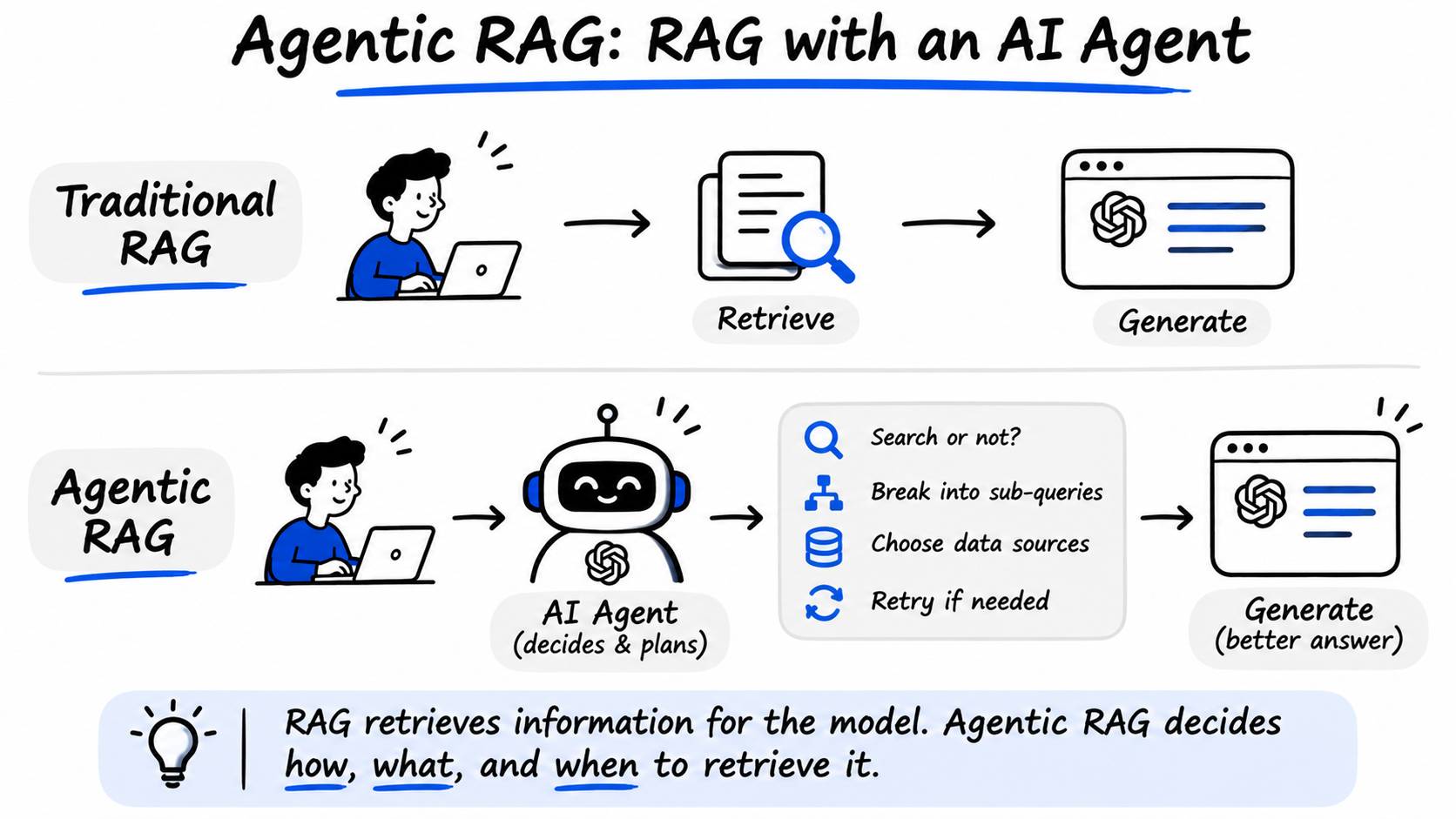
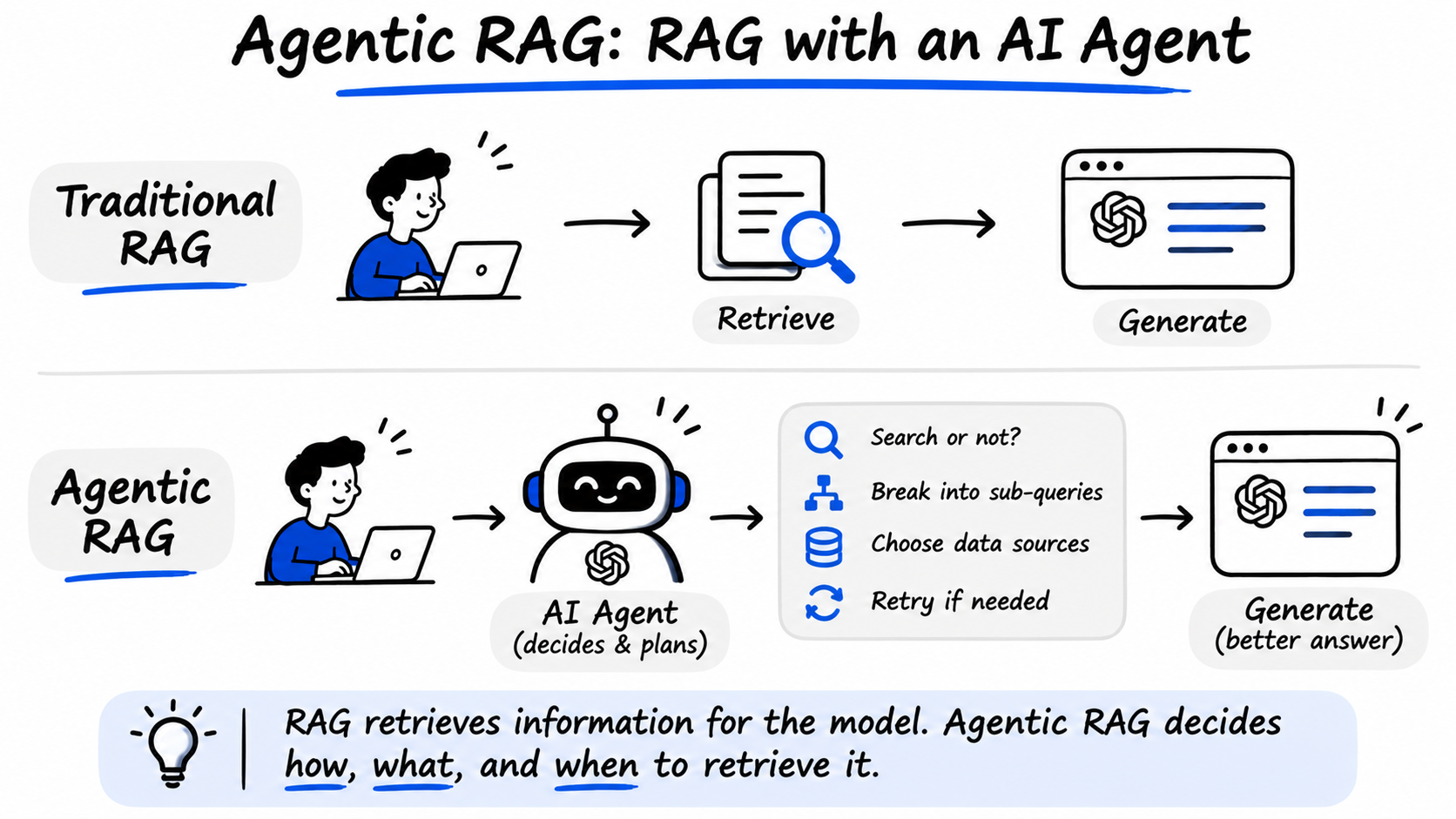
The agent can decide whether it needs to search, break a complicated question into smaller queries, select different data sources, evaluate retrieved information, and repeat the process when the available context is insufficient.
According to AWS's definition of Agentic RAG, the agent actively controls when and what to retrieve, which retrieval tools to use, and whether the available information is sufficient.
Traditional RAG retrieves information for the model. Agentic RAG allows the model to decide how information should be retrieved.
2. traditional RAG vs. Agentic RAG: what is the difference?
The easiest way to understand Agentic RAG is to compare it with the traditional retrieval pipeline.
Imagine asking an AI assistant:
"Compare PostgreSQL and MongoDB for a SaaS application that needs authentication, billing, and complex reporting."
A traditional RAG system receives the question, searches its knowledge base, retrieves relevant documents, and sends those documents to the language model.
It follows a predefined sequence.
Agentic RAG approaches the same question differently.
The agent might first search for information about PostgreSQL and MongoDB. It then identifies that the question also involves billing, authentication, and reporting. It can perform additional searches for transaction handling, relational data modeling, and reporting requirements before preparing its recommendation.
| Traditional RAG | Agentic RAG |
|---|---|
| Follows a predefined retrieval pipeline | Uses an agent to control retrieval |
| Usually starts with a fixed search query | Can rewrite and decompose queries |
| Often searches a predefined source | Can select from multiple sources |
| Retrieves context before generation | Can retrieve repeatedly during reasoning |
| Simpler and more predictable | More flexible but more complex |
| Suitable for straightforward questions | Useful for complex, multi-step questions |
Neither approach is universally better.
Traditional RAG is often sufficient for documentation search, frequently asked questions, and straightforward knowledge retrieval.
Agentic RAG becomes useful when the question requires multiple searches, dynamic source selection, or reasoning based on intermediate results.
Microsoft's Azure Architecture Center describes this distinction in its guidance on agentic retrieval architectures.
3. how does Agentic RAG actually work?
An Agentic RAG system combines several components that work together to retrieve information and generate a grounded response.
Here is a simplified workflow.
Step 1: understand the user's question.
The agent receives a request and identifies what information is required. If the question contains multiple requirements, it can break them into smaller subqueries.
Step 2: decide where to search.
The agent selects the appropriate retrieval tools. These might include vector databases, document repositories, SQL databases, APIs, or web search.
Step 3: retrieve relevant information.
The selected tools search their respective sources and return relevant documents, records, or other data.
Step 4: evaluate the results.
The agent examines the retrieved information. Are the sources relevant? Is anything missing? Do different sources contradict one another?
Step 5: retrieve more information if necessary.
If the results are insufficient, the agent can refine its search, ask another tool, or investigate a different source.
Step 6: generate the final response.
Once enough relevant information has been collected, the system combines the retrieved context and produces an answer.
The simplified architecture looks like this:
             User Question
                   |
                   v
             AI Agent
                   |
                   v
          Understand the Task
                   |
                   v
          Plan Retrieval Strategy
                   |
                   v
          Select Search Tools
                   |
          +--------+---------+
          |        |         |
          v        v         v
       Vector    Database   External
       Search     Search     APIs
          |        |         |
          +--------+---------+
                   |
                   v
           Evaluate Results
                   |
             Enough Data?
              /       \
            No         Yes
            |           |
            v           v
       Refine Search   Generate
       and Retrieve    Response
          Again           |
                          v
                    Final Answer
This process is sometimes implemented using a reasoning-and-action pattern, commonly known as ReAct.
The key idea is that retrieval and reasoning happen in an iterative loop rather than as two completely separate stages.
4. what are the main components of an Agentic RAG system?
Building Agentic RAG requires more than connecting an LLM to a vector database.
Several components work together to make retrieval dynamic and useful.
1. the AI model
The model interprets the user's question, decides what information is needed, selects tools, and evaluates retrieved results.
2. the agent orchestrator
The orchestrator manages the workflow. It coordinates model calls, tool execution, intermediate results, and decisions about whether the task is complete.
3. retrieval tools
These tools allow the agent to access external information. Examples include semantic search, keyword search, database queries, documentation search, and external APIs.
4. knowledge sources
These contain the information the agent retrieves. They can include vector databases, relational databases, internal documents, product documentation, and other structured or unstructured sources.
5. memory and context
Memory helps the agent retain relevant information across interactions. Context provides the information required for the current task, including previous messages and retrieved results.
6. evaluation and verification
The system needs mechanisms to assess whether retrieved information is relevant and whether the final response is supported by reliable sources.
These components work together to help the agent retrieve information, evaluate it, and decide what to do next.
Microsoft's Agentic RAG architecture documentation explains how retrieval tools, agent instructions, orchestration, and reasoning loops fit into this design.
5. real-world examples of Agentic RAG
Agentic RAG becomes particularly useful when an application needs to combine information from multiple sources rather than answer questions using a single document search.
Consider a few practical examples.
Enterprise knowledge assistants
An employee asks, "What is our current leave policy, and how does it differ from the policy last year?"
The agent searches the current HR documentation, retrieves the previous policy, compares the relevant sections, and generates an explanation with supporting references.
AI research assistants
A researcher asks, "Compare the latest approaches to reducing inference costs in large language models."
The agent can search research papers, retrieve technical reports, identify relevant methods, and compare their findings.
Customer support agents
A customer asks, "Why has my subscription payment failed, and what should I do?"
The agent might retrieve the customer's subscription details, check payment records, consult the relevant support documentation, and explain the likely issue.
AI coding assistants
A developer asks, "Why is authentication failing after the latest update?"
The agent can inspect the relevant code, search project documentation, examine recent changes, retrieve error logs, and investigate related tests.
In each example, the agent does not depend on one search result. It gathers information from different sources and uses intermediate findings to determine what to investigate next.
6. what are the advantages and limitations of Agentic RAG?
Agentic RAG provides flexibility, but that flexibility comes with additional engineering complexity.
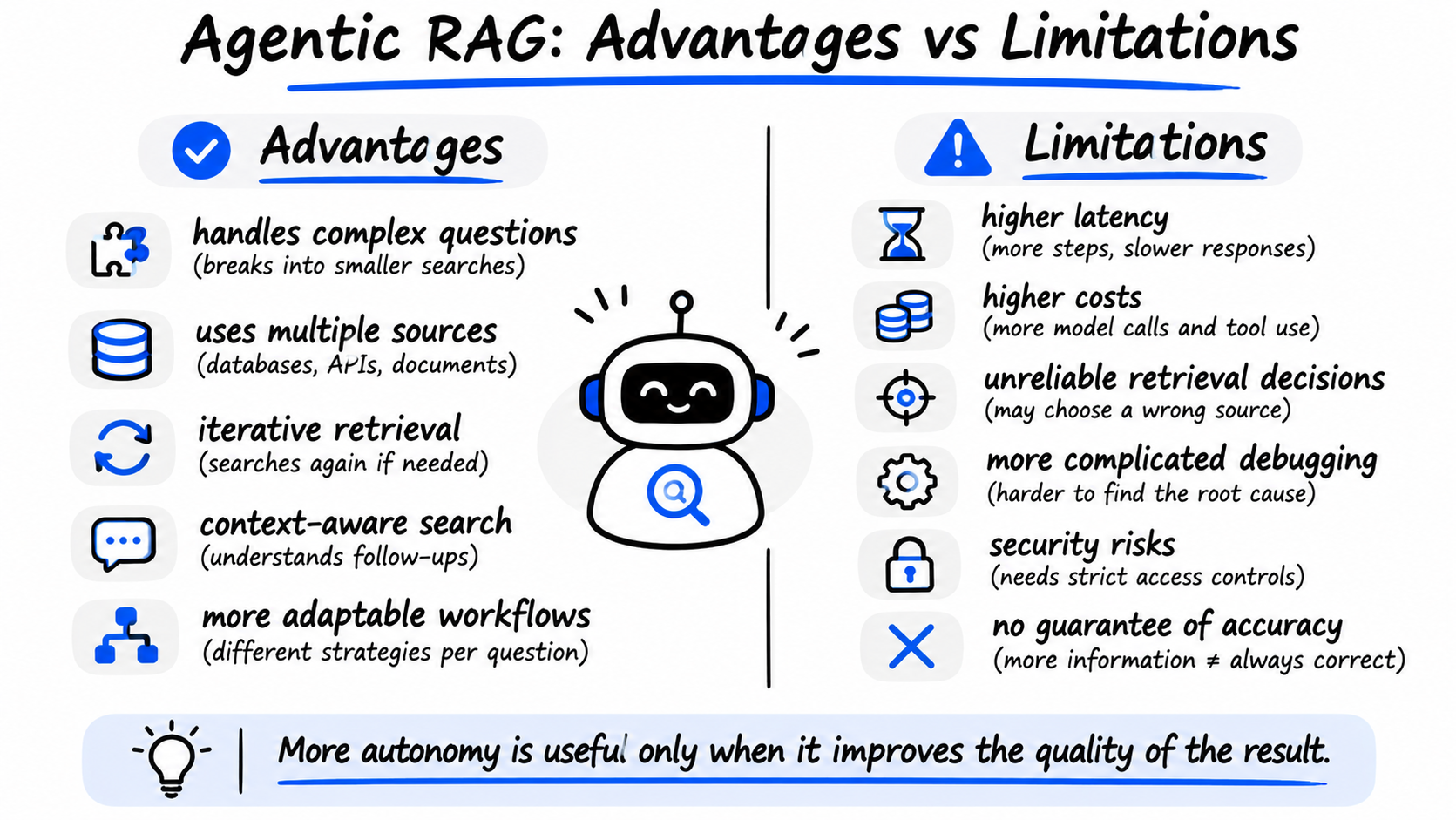
advantages
- Better handling of complex questions: The agent can decompose a question into smaller searches.
- Multiple information sources: It can retrieve information from databases, APIs, documents, and other systems.
- Iterative retrieval: It can search again when the initial results are incomplete.
- Context-aware search: It can use conversation history to understand follow-up questions.
- More adaptable workflows: Different questions can trigger different retrieval strategies.
limitations
- Higher latency: Multiple model calls and retrieval operations can make responses slower.
- Higher costs: Every additional reasoning step and tool call consumes resources.
- Unreliable retrieval decisions: The agent may choose an inappropriate source or generate poor search queries.
- More complicated debugging: It can be difficult to identify whether an incorrect answer came from retrieval, reasoning, or orchestration.
- Security risks: Agents connected to private databases and external tools need strict access controls.
- No guarantee of accuracy: Retrieving more information does not automatically produce a correct answer.
Microsoft specifically highlights the additional latency and complexity associated with agentic retrieval. Its architecture guidance recommends controlling the number of iterations and monitoring token consumption.
A well-designed system should have clear stopping conditions, retrieval limits, source validation, and a fallback when the agent cannot find sufficient evidence.
More autonomy is useful only when it improves the quality of the result.
7. when should developers use Agentic RAG?
One common mistake is assuming that every RAG application needs an autonomous agent.
It does not.
If your application answers straightforward questions from a relatively stable knowledge base, a traditional RAG pipeline may be faster, cheaper, and easier to maintain.
For example, a documentation chatbot that retrieves the relevant API reference and explains it probably does not need a complicated reasoning loop.
Agentic RAG becomes more valuable when the application must:
- Break complicated questions into multiple searches.
- Retrieve information from different databases or services.
- Decide dynamically which source is relevant.
- Compare information from multiple documents.
- Search again when the first results are incomplete.
- Combine retrieval with calculations or external API calls.
A useful engineering principle is to begin with the simplest retrieval architecture that solves the problem.
Introduce agentic behavior only when the application genuinely needs dynamic decisions.
This keeps the system easier to debug, reduces unnecessary model calls, and makes its performance more predictable.
conclusion: retrieval is becoming an intelligent process
Traditional RAG changed how AI applications access information. Instead of depending entirely on what a model learned during training, developers could connect models to external knowledge and provide relevant information at runtime.
Agentic RAG takes this idea further by giving AI agents control over how that information is discovered.
An agent can investigate a question, select retrieval tools, break down complex queries, evaluate results, and search again when necessary.
This creates opportunities for more capable research assistants, enterprise knowledge systems, customer support applications, and AI-powered development tools.
But it also introduces new responsibilities. Developers must control retrieval loops, validate information, manage permissions, and measure whether additional reasoning actually improves the answer.
The future of AI applications will not depend only on models that know more. It will increasingly depend on systems that know how to find the right information when they need it.
"Intelligence is not just knowing the answer. Sometimes, it is knowing where to look, what to question, and when to search again."
references
- AWS, Agentic AI Lens: Definitions and Agentic RAG: https://docs.aws.amazon.com/wellarchitected/latest/agentic-ai-lens/definitions.html
- Microsoft, Develop an Agentic RAG Solution: https://learn.microsoft.com/en-gb/azure/architecture/ai-ml/guide/rag/rag-agentic
- Microsoft, Retrieval-Augmented Generation and Indexes in Microsoft Foundry: https://learn.microsoft.com/en-us/azure/foundry/concepts/retrieval-augmented-generation
- UK Government, AI Insights: Agentic RAG: https://www.gov.uk/government/publications/ai-insights/ai-insights-agentic-rag-html
- IBM, What Is Agentic RAG?: https://www.ibm.com/think/topics/agentic-rag
- Microsoft, Agentic Retrieval Overview: https://learn.microsoft.com/en-us/azure/search/agentic-retrieval-overview
- AWS, Basic Reasoning Agents and Agent RAG: https://docs.aws.amazon.com/prescriptive-guidance/latest/agentic-ai-patterns/basic-reasoning-agents.html