
What if one AI company spends billions of dollars building an advanced model, and another company learns from its answers to build a competing model?
It sounds like an unusual shortcut, but this is already part of the modern AI industry.
AI companies are increasingly using powerful models to generate training data, evaluate responses, improve reasoning, and teach smaller models to perform tasks that would otherwise require expensive training.
The technique behind much of this is called model distillation.
It is also becoming a major point of tension between AI companies. OpenAI and Anthropic have publicly accused competitors of using their models to extract capabilities at scale. Recent reports have brought this debate back into the spotlight.
So how does one AI model teach another? Is it actually possible to transfer intelligence between models? And where is the line between legitimate research and copying another company's work?
1. what is model distillation?
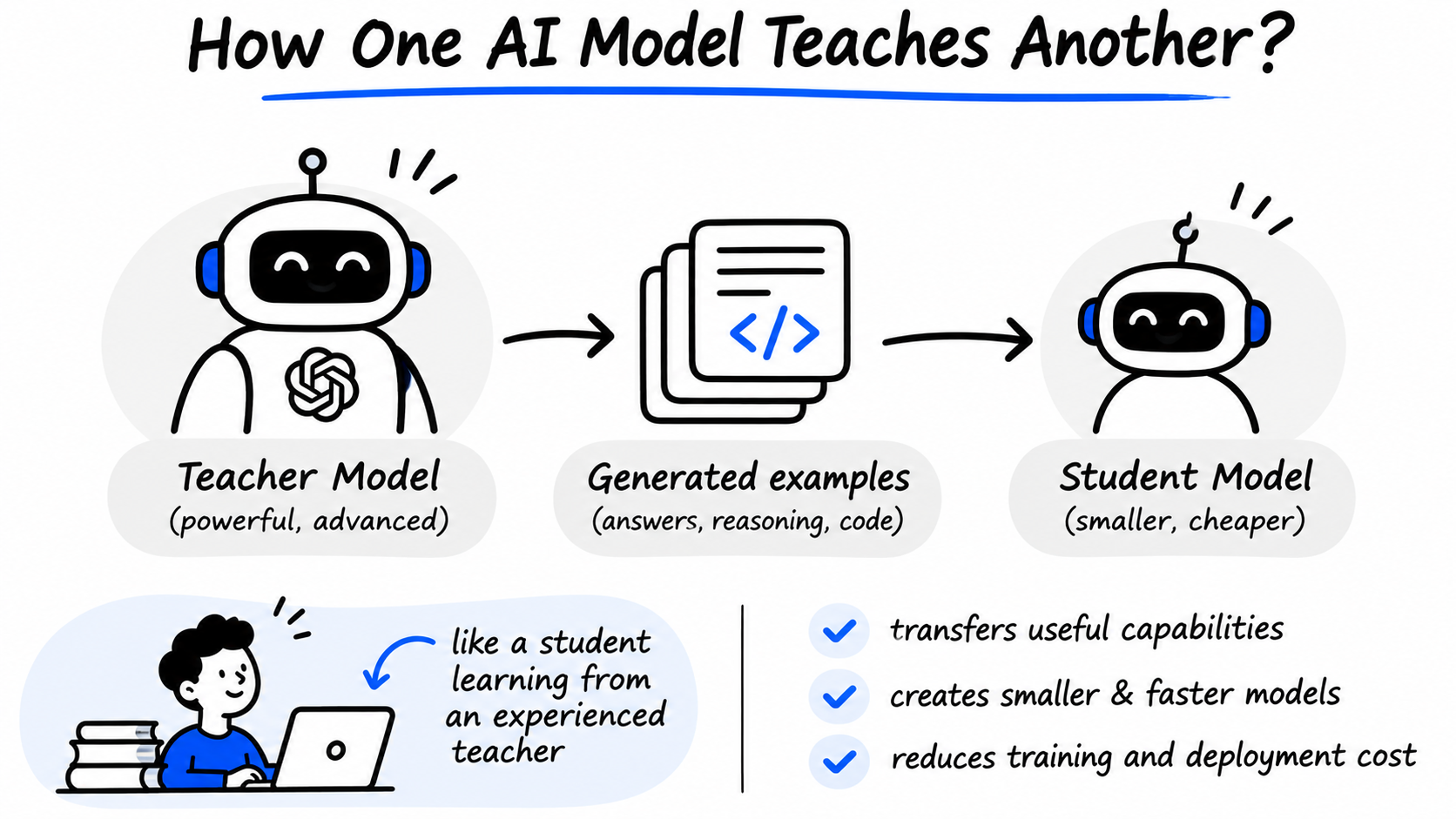
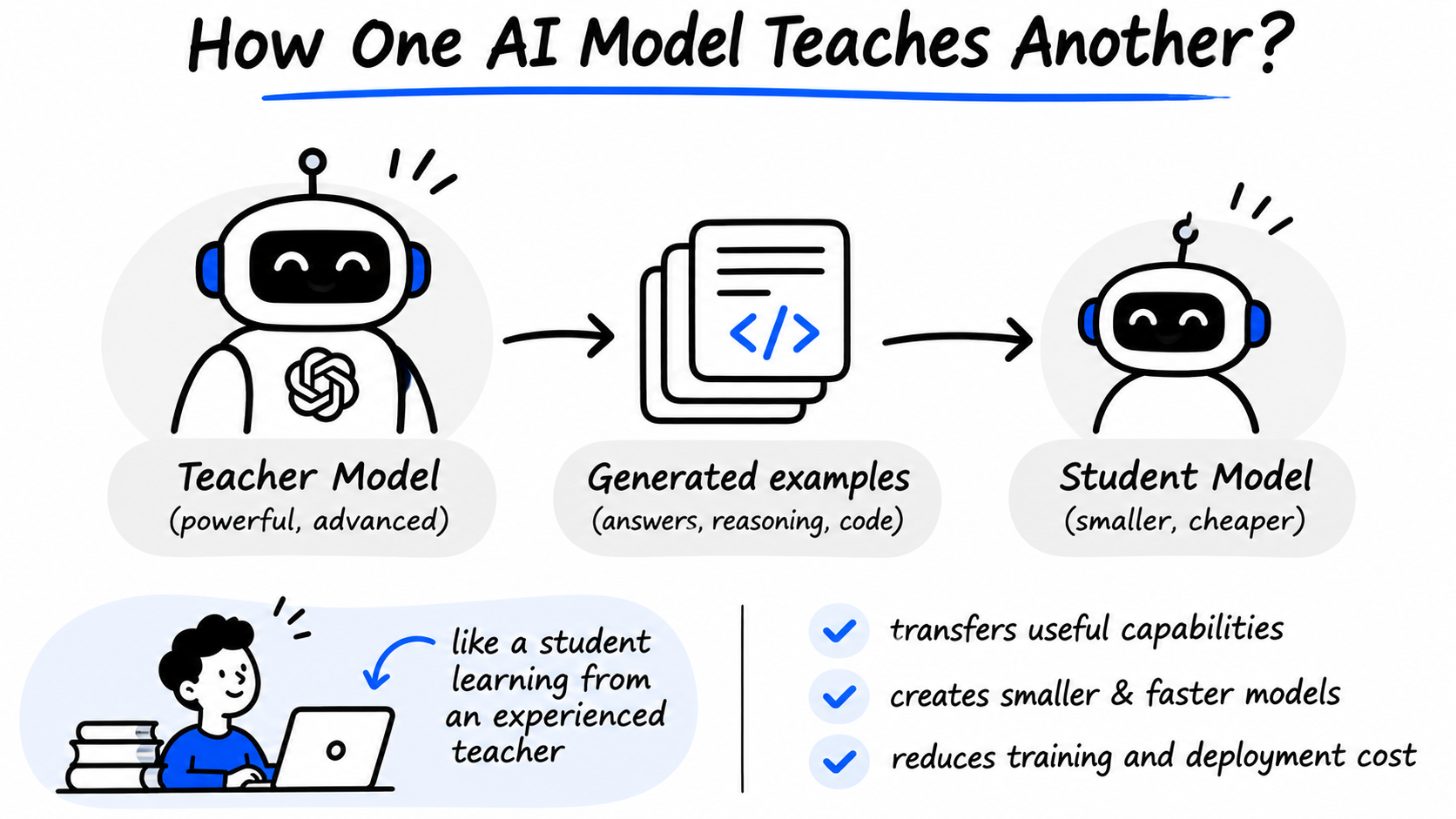
Imagine a student learning mathematics from an experienced teacher.
The teacher already understands complicated concepts and knows how to solve difficult problems. Instead of making the student discover every solution independently, the teacher provides examples, explanations, and feedback.
Over time, the student learns to solve similar problems independently.
Model distillation works on a similar principle.
A powerful AI model acts as the teacher, generating responses to carefully selected questions. A smaller or less capable model acts as the student, learning from those responses during training.
The goal is to make the student reproduce useful capabilities of the teacher while requiring fewer computational resources during deployment.
For example, a company might use a powerful model to generate thousands of examples involving mathematics, programming, reasoning, and question answering. It can then use those examples to train a smaller model.
The smaller model does not simply copy and paste the answers. Its parameters are updated during training so that it learns patterns from the generated examples.
The UK government's AI Insights report explains model distillation through this teacher-student approach and highlights its importance for making capable models cheaper and more practical to deploy.
This is why distillation is widely used in AI research. It allows developers to transfer useful behavior into models that are smaller, faster, or less expensive to operate.
2. how does one AI model teach another?
Let's understand the process through a simple example.
Imagine a company wants to build a model that can solve programming problems.
Training a capable coding model from scratch requires large datasets, substantial computing resources, and considerable engineering effort.
Instead, the company can use an existing powerful model to generate training examples.
The process generally looks like this:
Step 1: prepare questions.
The company creates thousands of programming problems covering algorithms, debugging, code generation, and software architecture.
Step 2: ask the teacher model.
A powerful AI model receives these questions and generates solutions, explanations, and sometimes multiple approaches to each problem.
Step 3: collect and filter responses.
The company evaluates the generated answers, removes incorrect examples, and keeps useful training data.
Step 4: train the student model.
The smaller model learns from these examples through supervised fine-tuning or other training techniques.
Step 5: evaluate performance.
The resulting model is tested on problems it has not previously encountered to determine whether it has learned general capabilities rather than simply memorizing examples.
<escape>Here is the simplified process:</escape>
          Programming questions
                    |
                    v
             Teacher Model
             (Powerful AI)
                    |
                    v
          Generated solutions
                    |
                    v
           Data filtering
                    |
                    v
             Student Model
             (Smaller AI)
                    |
                    v
          Training and evaluation
                    |
                    v
          Deployable AI Model
The important part is that the student model learns from the teacher's outputs. It does not automatically receive the teacher's original weights, architecture, or internal parameters.
That distinction matters because model distillation is not the same as downloading another company's model and copying its internal structure.
3. why are AI companies using other AI models for training?
Training frontier AI models is expensive.
Companies need powerful GPUs, large datasets, experienced researchers, infrastructure, and months of experimentation. Even after spending enormous resources, there is no guarantee that a new model will perform better.
Distillation provides another route.
Instead of generating every training example manually or relying entirely on raw internet data, companies can use an existing model to produce structured, task-specific examples.
There are several reasons this is useful.
Lower training costs: Smaller models can learn useful capabilities without requiring the same scale of resources as frontier models.
Faster development: Researchers can generate large quantities of specialized examples relatively quickly.
Better task specialization: A general-purpose model can help produce examples for coding, mathematics, translation, customer support, or other specific tasks.
Improved efficiency: A smaller distilled model can sometimes provide comparable performance on a particular task while requiring less computing power at inference time.
Synthetic training data: Companies can create additional training examples even when high-quality human-written datasets are limited.
However, distillation is not magic. A student model does not automatically inherit everything its teacher knows. Its performance depends on the quality and diversity of training examples, the underlying model, and the training process.
A smaller model can become very capable in a particular domain without becoming an exact replacement for its teacher.
4. why are OpenAI and Anthropic concerned about AI distillation?
This is where the discussion becomes controversial.
Distillation itself is a legitimate machine learning technique. AI companies use it to create smaller versions of their own models and improve the efficiency of their products.
The controversy begins when one company allegedly uses another company's restricted model access to extract capabilities at scale without authorization.
In February 2026, Anthropic accused DeepSeek, Moonshot, and MiniMax of conducting large-scale campaigns to extract capabilities from Claude.
According to Anthropic, the campaigns generated more than 16 million exchanges through approximately 24,000 fraudulent accounts. The company said the activity targeted capabilities including reasoning, coding, and agentic tool use.
Anthropic described the activity as unauthorized distillation and said the accounts violated its terms of service.
OpenAI raised similar concerns about DeepSeek in February 2026. It told US lawmakers that it had observed accounts associated with DeepSeek employees obtaining outputs from American AI models through methods designed to evade access restrictions.
These are allegations made by the companies involved, not independently established findings about every training practice used by their competitors.
The distinction is important.
Using your own powerful model to train a smaller model is a normal engineering practice. Systematically extracting a competitor's protected capabilities through deceptive access is a different matter.
The debate is not about whether models can learn from other models. They clearly can.
It is about who has the right to collect those outputs, under what conditions, and whether the process violates contractual, legal, or intellectual property protections.
5. the latest controversy: DeepSeek, Moonshot, and GPT-6 Astra
The model distillation debate became even more interesting in October 2026.
On October 29, Reuters reported on a story from The Information claiming that Chinese AI developers DeepSeek and Moonshot AI had relied heavily on outputs from OpenAI's GPT-6 Astra to train their latest models.
The report specifically mentioned Moonshot's Kimi K3.1 Pro and DeepSeek's upgraded V4.1-Flash 1017.
According to the report, the companies benefited from distilling Astra's outputs. OpenAI, DeepSeek, and Moonshot did not immediately respond to Reuters' requests for comment.
This report adds another development to the existing dispute over model distillation.
OpenAI had already published a September 30, 2026, account describing a coordinated campaign designed to extract protected reasoning from its models. It attributed a core cluster of the activity to individuals associated with Moonshot AI.
Anthropic also published an updated threat intelligence report in September describing additional distillation campaigns against Claude.
These developments show why frontier AI companies are paying increasing attention to how their models are accessed and how their outputs are used.
However, it is important not to confuse a reported allegation with a proven account of how an entire competing model was trained. Public reporting does not reveal the complete training pipelines or establish how much of a model's performance came from any particular teacher.
6. can a smaller AI model become as intelligent as its teacher?
This is probably the most interesting technical question.
The short answer is that a smaller model can sometimes approach or even outperform a larger model on specific tasks, but that does not mean it has inherited all the capabilities of its teacher.
Suppose a large model is excellent at mathematics, but expensive to operate.
A company could generate a large collection of mathematical problems and solutions, then train a smaller model specifically for mathematical reasoning.
After sufficient training, the student might perform extremely well on mathematics benchmarks while remaining weaker at creative writing, general knowledge, or complex software engineering.
This is because distillation transfers patterns through training data. It does not guarantee identical general intelligence.
There is another interesting research development.
A 2026 study published in Nature explored something called subliminal learning. Researchers found that student models could inherit certain behavioral traits from teacher models even when the generated training data did not contain obvious references to those traits.
The findings suggest that information transferred through distillation may be more subtle than simply copying visible answers.
This raises important questions about how researchers evaluate distilled models, especially when safety-related behaviors can also be transferred through training.
Distillation can therefore transfer useful capabilities, but it can also introduce unexpected behaviors that require careful evaluation.
7. does model distillation threaten the future of AI companies?
Distillation could change the economics of the AI industry.
If a company can build a smaller, capable model using carefully generated training data, it may not need to spend the same amount of money operating a massive model for every request.
This could make advanced AI more accessible to startups, independent developers, and businesses with limited computing budgets.
It could also increase competition because smaller companies may be able to build specialized models without reproducing the entire research and infrastructure investment of frontier laboratories.
But there are limits.
Access to a powerful teacher does not automatically provide the architecture, training expertise, infrastructure, data quality, or safety engineering required to build a competitive model.
And if distillation becomes dependent on unauthorized access to competitors' systems, model providers will respond with stronger monitoring, account restrictions, output controls, and other protections.
The industry will need clearer expectations around model access, training rights, and the responsible use of synthetic data.
Ultimately, distillation is likely to remain an important part of AI development. The debate will focus on how it is performed, not simply whether it should exist.
conclusion: AI is becoming both the teacher and the student
The AI industry is entering an interesting phase. Models are no longer just learning from human-written books, websites, and datasets. They are increasingly learning from the outputs of other models.
A powerful model can teach a smaller one how to solve problems, generate code, explain concepts, and perform specialized tasks. This can reduce development costs and make advanced capabilities more accessible.
But it also creates difficult questions about ownership, intellectual property, safety, and fair competition.
The most interesting possibility is that future AI systems will increasingly be trained through generations of other AI systems. One model will produce training data, another will learn from it, and a third may improve upon the result.
AI companies are not just competing to build the smartest model anymore. They are also competing to build the most effective systems for learning from intelligence that already exists.
"Perhaps the biggest change in artificial intelligence is that machines are no longer learning only from humans. They are beginning to teach one another."
references
- Anthropic, Detecting and Preventing Distillation Attacks, February 2026: https://www.anthropic.com/news/detecting-and-preventing-distillation-attacks
- OpenAI, Disrupting a Coordinated Model-Distillation Campaign, September 30, 2026: https://openai.com/index/disrupting-a-coordinated-model-distillation-campaign/
- Reuters, DeepSeek and Moonshot Used OpenAI's GPT-6 Astra to Train Latest Models, October 29, 2026: https://www.reuters.com/technology/deepseek-moonshot-used-openais-gpt-6-astra-train-latest-models-information-2026-10-29/
- Anthropic, Countering Misuse of AI: September 2026: https://www.anthropic.com/threat-intelligence-report-september-2026
- UK Government, AI Insights: Model Distillation, August 2026: https://www.gov.uk/government/publications/ai-insights/ai-insights-model-distillation-html
- Nature, Language Models Transmit Behavioural Traits Through Hidden Signals in Data, 2026: https://www.nature.com/articles/s41586-026-10319-8
- Reuters, OpenAI Says DeepSeek Trained Its AI by Distilling US Models, February 2026: https://www.reuters.com/world/china/openai-accuses-deepseek-distilling-us-models-gain-advantage-bloomberg-news-2026-02-12/