
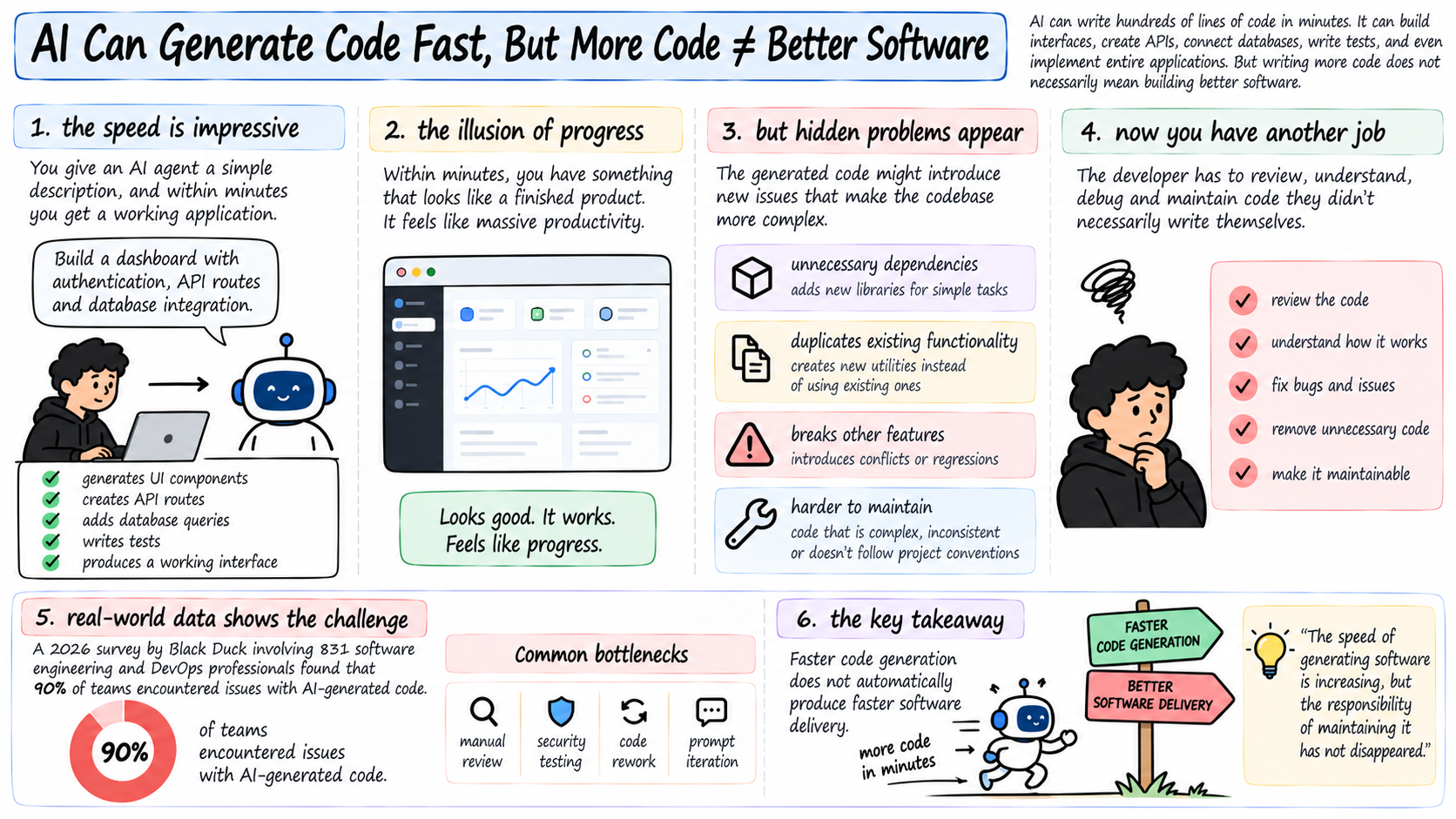
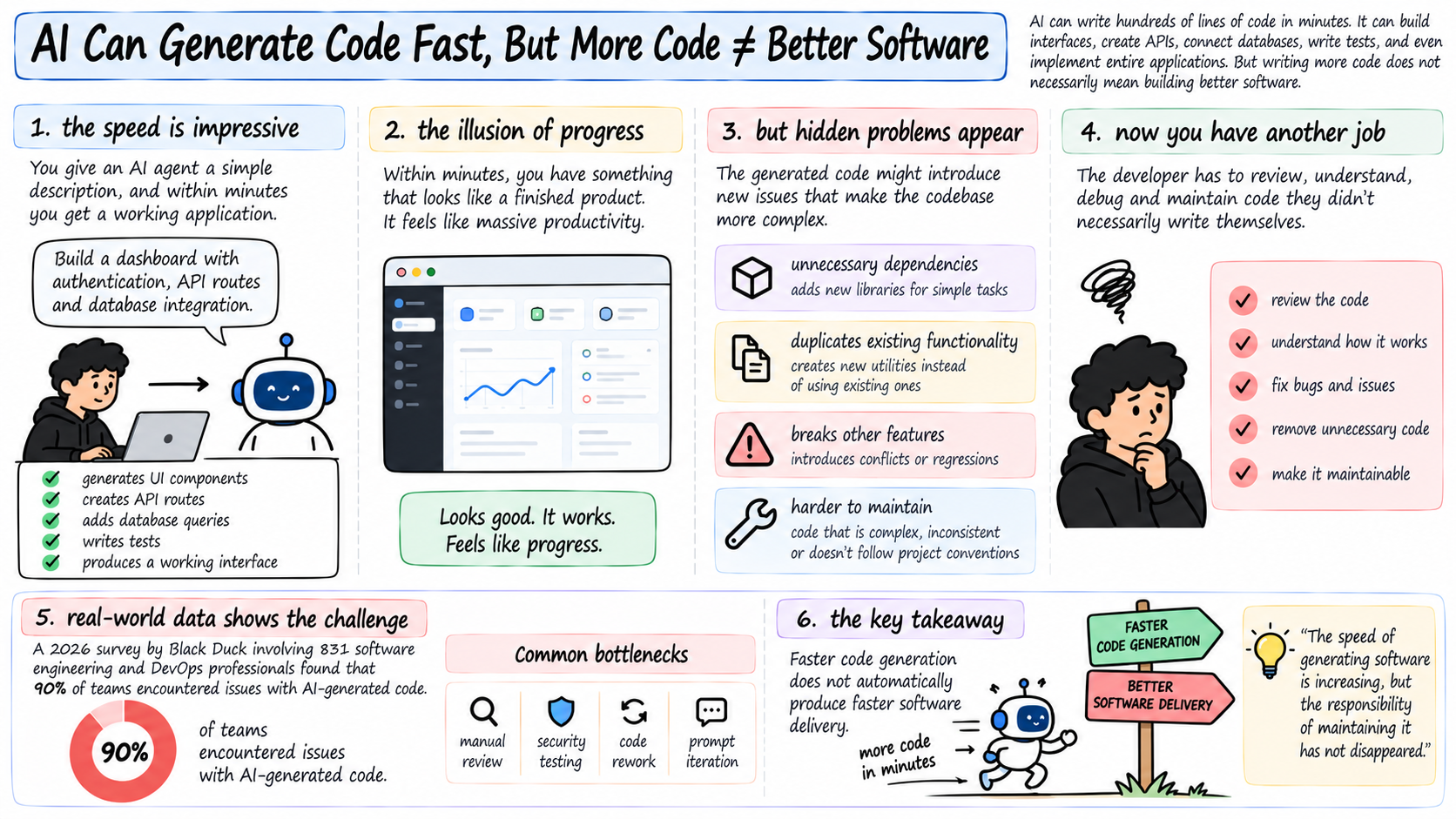
AI can generate hundreds of lines of code in a few minutes. It can build interfaces, create APIs, connect databases, write tests, and even implement entire applications from a simple description.
But there is a problem nobody should ignore: writing more code does not necessarily mean building better software.
A developer might spend three hours implementing a feature manually. An AI coding agent might produce a working version in fifteen minutes. That sounds like a massive productivity improvement.
But what happens when the generated code introduces unnecessary dependencies, duplicates existing functionality, breaks another feature, or becomes difficult to maintain?
The developer now has another job: understanding, reviewing, debugging, and maintaining code they did not necessarily write themselves.
This is the hidden cost of AI coding. The speed of generating software is increasing, but the responsibility of maintaining it has not disappeared.
1. the illusion of faster software development
For a long time, developers measured progress through completed features, resolved bugs, and shipped releases. AI coding tools have introduced another tempting metric: how much code can be generated in a given amount of time.
This creates an interesting illusion.
Imagine asking an AI agent to build a dashboard. It generates several components, creates API routes, adds database queries, and produces a working interface. Within minutes, you have something that looks like a finished product.
But a working preview does not tell you whether the architecture is appropriate, whether the code follows existing conventions, or whether the implementation handles unexpected situations.
The agent might create a new utility when the project already has one. It might duplicate business logic across multiple components. It might introduce a library to solve a problem that requires only a few lines of existing code.
The feature works, but the codebase becomes more complicated.
A 2026 survey by Black Duck involving 831 software engineering and DevOps professionals found that 90% of teams encountered issues with AI-generated code. Common bottlenecks included manual review, security testing, code rework, and prompt iteration.
The lesson is straightforward: faster code generation does not automatically produce faster software delivery.
2. technical debt is becoming easier to accumulate
Technical debt is the future cost of choosing an implementation that makes software harder to maintain or extend.
It is not always caused by bad programming. Sometimes developers deliberately take shortcuts to meet deadlines. Problems arise when those shortcuts become difficult to replace.
AI coding agents can introduce technical debt in less obvious ways.
For example, an agent might generate a second implementation of an existing feature because it did not discover the original one. Another agent might add unnecessary abstractions, create redundant database queries, or use outdated APIs.
Individually, these changes may look harmless. Over several months, they can create a codebase that becomes increasingly difficult to understand.
A particularly interesting study published on arXiv in October 2026 examined more than 302,000 verified AI-authored commits across 6,299 GitHub repositories. Researchers identified hundreds of thousands of issues, including code smells, correctness problems, and security concerns. Their analysis found that approximately 22.7% of tracked AI-introduced issues remained in the repositories' latest versions.
This does not mean every AI-generated change introduces technical debt. It does show why teams need to monitor the long-term quality of generated code rather than judging it only by whether the feature initially works.
The dangerous part of technical debt is that it rarely looks expensive when it first appears.
3. more code means more code to review
There is a difference between generating code and understanding it.
When a developer writes a feature, they usually make a series of decisions along the way. They understand why a particular function exists, which alternatives they considered, and how the implementation connects to the rest of the system.
With AI-generated code, the developer may receive an entire implementation without having participated in every decision.
Now imagine reviewing a pull request containing 1,500 lines of generated changes.
You need to understand what was modified, identify unnecessary additions, inspect dependencies, check security assumptions, and determine whether existing functionality has been affected.
The implementation might have taken fifteen minutes to generate, but reviewing it properly could take much longer.
Research published in IEEE Transactions on Software Engineering in 2026 examined AI-assisted programming and code ownership. In an experiment involving 69 participants, researchers observed that participants using AI achieved substantially higher task completeness, but also showed a 12.5% reduction in their ability to answer technical questions about the code they had implemented.
The result raises an important question: if developers increasingly generate code they do not fully understand, who will maintain that code when something breaks?
AI can reduce the effort required to write software. It cannot automatically transfer ownership of that software away from the engineering team.
4. the dependency problem: when AI installs a library for everything
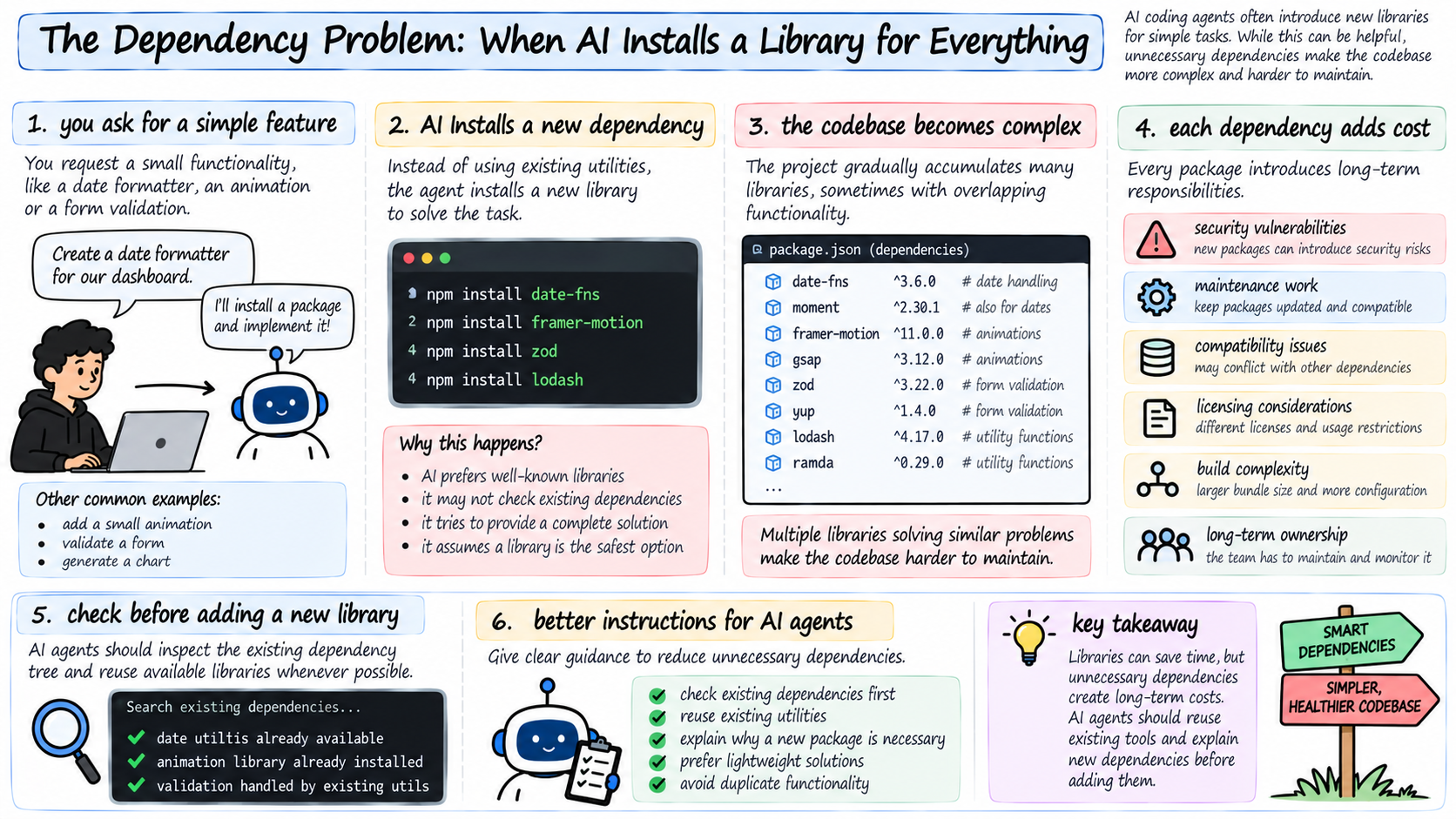
One of the easiest ways for AI to make a codebase unnecessarily complicated is by introducing dependencies.
Ask an AI agent to implement a date formatter, and it might install a package. Ask it to create a small animation, and it might introduce another library. Ask it to validate a form, and it might add an entire validation framework.
Sometimes these decisions are perfectly reasonable. Established libraries can save time and prevent developers from reinventing complex functionality.
But unnecessary dependencies create long-term responsibilities.
Every package becomes something the project must maintain, update, monitor, and potentially secure. Dependencies can introduce vulnerabilities, compatibility problems, licensing considerations, and additional build complexity.
The problem becomes worse when agents make these decisions independently across different features.
A project can gradually accumulate several libraries that solve similar problems, even though one shared dependency or a small internal utility would have been sufficient.
This is why AI coding agents should inspect the existing dependency tree before introducing new packages.
A useful instruction is simple: reuse existing libraries and utilities whenever appropriate, and explain why a new dependency is necessary before adding it.
5. AI-generated tests can create false confidence
Testing is supposed to provide evidence that software behaves correctly.
But AI-generated tests can sometimes create the appearance of quality without adequately checking the behavior that matters.
Consider an agent implementing a payment integration. It creates tests for successful payments, verifies that the expected response is returned, and reports that everything passes.
But what about failed payments? Duplicate webhook events? Expired sessions? Invalid amounts? Unexpected database failures?
If the tests cover only the expected path, important problems can remain hidden.
There is another issue: an AI agent may write tests that simply reproduce its own implementation assumptions. If both the feature and the tests contain the same misunderstanding, the tests might pass while the application remains incorrect.
Developers should therefore evaluate test quality, not just test quantity.
Good testing includes negative cases, boundary conditions, integration behavior, authorization checks, and realistic failure scenarios.
For important systems, independent review and security testing are essential.
A passing test suite is useful evidence. It is not proof that the application is correct.
6. why AI-native engineering needs a different definition of productivity
If AI makes developers faster at producing code, measuring productivity through lines of code becomes even less useful.
A developer who generates 2,000 lines of unnecessary code has not necessarily created more value than someone who solves the same problem with 200 well-designed lines.
The better question is how much reliable functionality a team can deliver and maintain.
That means engineering teams should pay attention to:
- Change failure rate: How often do releases introduce problems?
- Code review effort: How much time is required to understand and approve AI-generated changes?
- Defect rates: How many bugs appear after implementation?
- Rework: How much generated code needs to be rewritten?
- Maintainability: Can another developer understand and extend the implementation?
- Delivery time: How long does it take to move from a requirement to a reliable production release?
AI should improve these outcomes, not simply increase the amount of code produced.
The best engineering teams will use agents to accelerate implementation while maintaining strict standards for architecture, testing, security, and code review.
The objective is not to generate more software. It is to reduce the effort required to deliver software that works.
7. how developers can avoid the hidden cost of AI coding
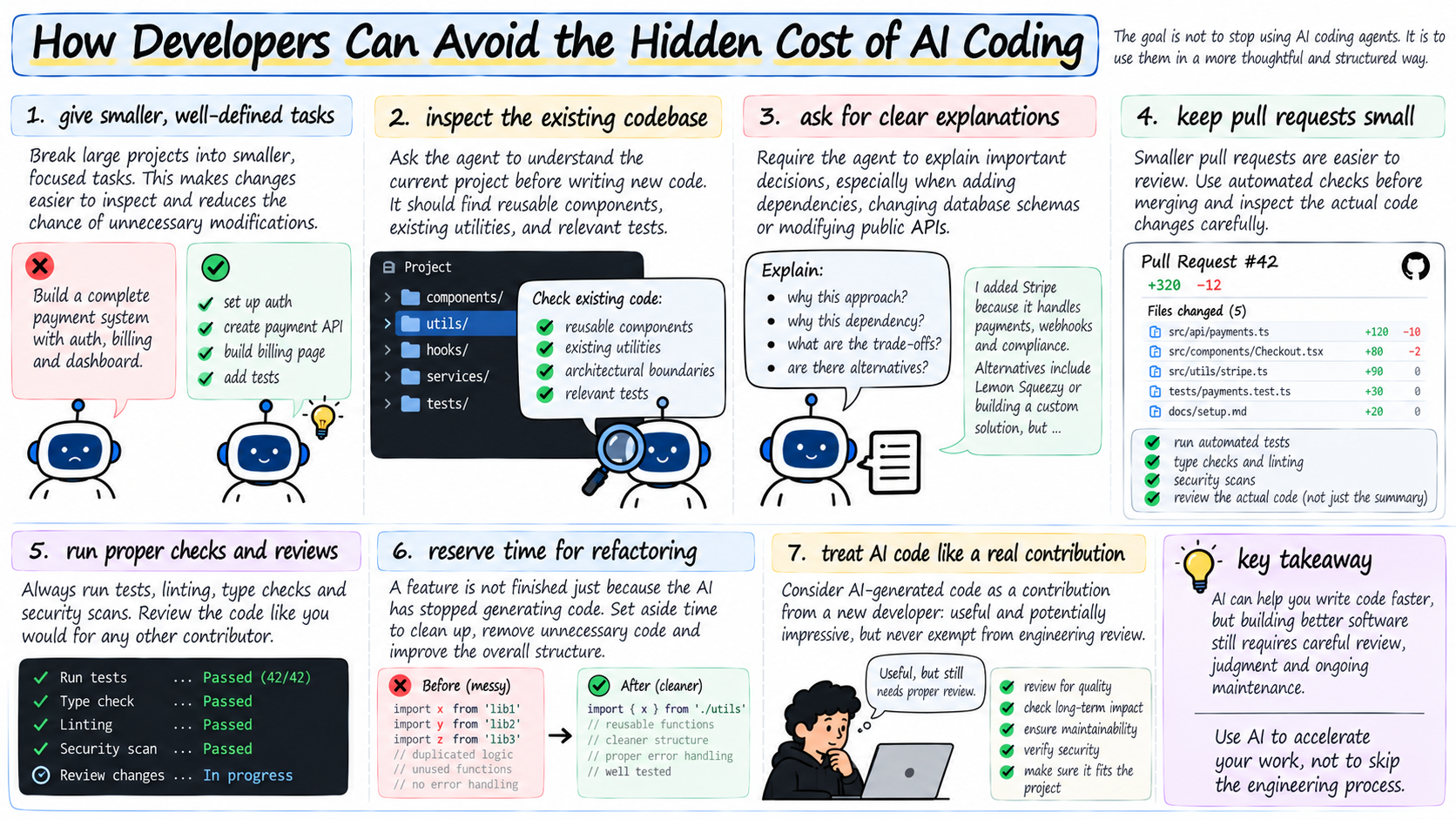
The answer is not to stop using AI coding agents. It is to change how they are used.
Start by giving agents smaller, well-defined tasks instead of asking them to build entire systems in one attempt. This makes changes easier to inspect and reduces the chance of unnecessary modifications.
Ask agents to inspect the existing codebase before implementing new functionality. They should identify reusable components, existing utilities, architectural boundaries, and relevant tests.
Require them to explain significant implementation decisions, especially when introducing dependencies, modifying database schemas, or changing public APIs.
Keep pull requests small. Run automated tests, type checks, linting, and security scans before merging. Review the actual code changes rather than relying on the agent's explanation of what it claims to have done.
Most importantly, reserve time for refactoring and maintenance. A feature is not finished simply because the AI has stopped generating code.
A practical rule is to treat AI-generated code like a contribution from a new developer: useful, potentially impressive, but never exempt from engineering review.
conclusion: the future is not about writing more code
AI has fundamentally changed how quickly software can be created. Developers can experiment faster, build prototypes with fewer resources, and automate many repetitive implementation tasks.
But the ability to generate code cheaply introduces a new responsibility: making sure that the code is worth keeping.
Technical debt, unnecessary dependencies, weak tests, security vulnerabilities, and reduced code ownership can quietly erase the productivity gains that AI initially provides.
The teams that succeed will not be the ones producing the largest codebases or accepting the most AI-generated pull requests. They will be the ones that know what to automate, what to review, and what should never be added in the first place.
Because software engineering has never been about how much code you can write.
It has always been about how well you can solve a problem.
"AI has made writing code cheaper. It has not made maintaining bad code any cheaper."
references
- Debt Behind the AI Boom: A Large-Scale Empirical Study of AI-Generated Code in the Wild, arXiv, 2026
- The State of AI-Powered Software Development, Black Duck, 2026
- More Code, Less Understanding? On the Impact of AI Assistants on Developers' Productivity and Code Ownership, IEEE Transactions on Software Engineering, 2026
- Evolving with AI: A Longitudinal Analysis of Developer Logs, JetBrains Research, 2026
- Refining ChatGPT-Generated Code: Characterizing and Mitigating Code Quality Issues, ACM, 2024