
Imagine waking up in the morning and finding that your AI has already checked your emails, reviewed your calendar, identified an important meeting, prepared a briefing, and drafted replies to messages that need your attention.
You never opened a chatbot. You never wrote a prompt. The AI simply noticed what needed to be done and got started.
This is the idea behind Claude Duet, Anthropic's new proactive AI agent announced on October 21, 2026.
For years, people have used AI by asking questions and waiting for answers. Claude Duet introduces a different experience: instead of waiting for you to start every interaction, it can monitor connected applications, identify important work, complete delegated tasks, and contact you when it needs a decision.
It is a significant step toward a future where AI does not just help you think. It helps you get things done.
1. what is Claude Duet?
Claude Duet is a proactive AI agent developed by Anthropic. It is designed to help professionals and small business owners manage their work by connecting to their applications, handling delegated tasks, and identifying things that require their attention.
Unlike the regular Claude chatbot, which primarily responds when you open a conversation and ask something, Duet can initiate interactions based on what it discovers across your connected accounts.
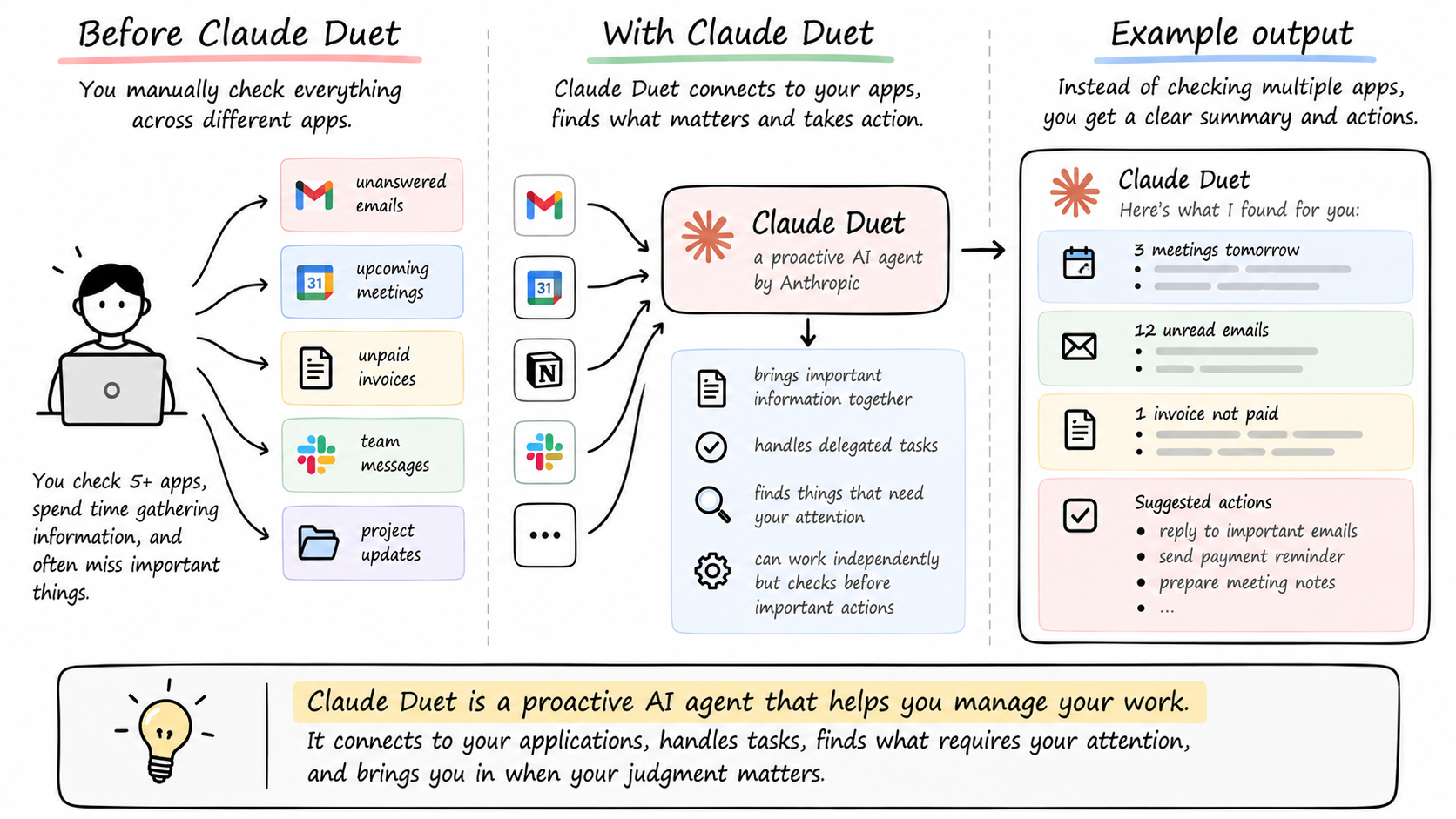
For example, imagine you have three meetings tomorrow, several unanswered emails, and an invoice that has not been paid. Instead of manually checking five different applications, Claude Duet can bring the important information together and prepare a summary.
You can also give it larger assignments, such as preparing a financial forecast, researching a company, creating a dashboard, or building a web application.
Anthropic describes it as an agent that works independently but checks with you before taking important actions. Its central idea is simple: you should not have to manage every small task when an AI agent can handle the work and bring you in when your judgment matters.
2. how does Claude Duet actually work?
The interesting part of Claude Duet is not just its ability to answer questions. It is how it operates between conversations.
When you give it a task, Duet determines which applications and tools it needs, works through the required steps, and sends you an update when the task is complete or requires your input.
It operates using its own virtual computer in the cloud, including a browser. This means it can continue working even after you close the app or switch off your laptop.
For example, you could tell it:
"Review my calendar for tomorrow, identify meetings that need preparation, and create a short briefing for each one."
Duet can examine the relevant calendar information, gather details from connected applications, and prepare the briefings. You can then review the results without manually collecting information from different sources.
It also maintains an ongoing conversation, allowing you to follow up on earlier tasks rather than explaining the entire situation again.
The product carries over your existing Claude memory, skills, and connected applications, making it easier to continue working without rebuilding your setup from scratch.
3. what can Claude Duet do?
Claude Duet is designed for more than simple reminders and summaries. Anthropic wants it to handle meaningful parts of everyday professional work.
Here are some examples of what it can do:
Manage your inbox: Find important emails, summarize conversations, identify unanswered messages, and prepare replies for your approval.
Organize your calendar: Review upcoming meetings, identify scheduling conflicts, prepare meeting briefs, and help arrange appointments.
Handle business operations: Check for unpaid invoices, prepare payment reminders, organize accounting information, and assist with payroll workflows.
Build dashboards and reports: Gather information from connected tools and turn it into dashboards, forecasts, research briefs, and other useful documents.
Support marketing and sales: Prepare social media campaigns, draft follow-up emails, organize customer information, and assist with business research.
Build software: Help prototype ideas and create web applications, using its connected tools and cloud environment.
One particularly interesting detail is its integration ecosystem. Anthropic says Claude Duet supports more than 6,000 connectors and plugins through the Claude Marketplace.
These integrations can connect it to services such as Gmail, Slack, QuickBooks, Stripe, HubSpot, Canva, DocuSign, and Shopify.
This changes the possibilities considerably. An AI agent becomes more useful when it can interact with the applications where actual work happens.
4. Claude Duet vs. regular Claude: what is the difference?
The easiest way to understand Duet is to compare it with the regular Claude experience.
| Regular Claude | Claude Duet |
|---|---|
| Primarily responds to your prompts | Can proactively contact you |
| Works mainly through conversations | Works across connected applications |
| Helps with individual requests | Can manage multi-step assignments |
| You initiate most interactions | Can identify tasks that need attention |
| Work generally happens during your session | Can continue working in the cloud |
| Provides answers and generated content | Can prepare and perform actions with approval |
Imagine asking regular Claude to summarize your inbox. It can help when you ask.
With Duet, the idea is different. It can check connected accounts periodically, prepare a morning briefing, and bring important messages to your attention without requiring you to start the process every time.
That is the fundamental shift: from an AI assistant that waits for instructions to an agent that can take initiative.
However, this does not mean Duet understands everything perfectly or should make every decision independently. Its ability to prioritize and interpret information is still being refined.
5. what powers Claude Duet?
Claude Duet is built around Anthropic's Claude Opus 5.5 model.
But the model itself is only one part of the system.
To function as a proactive agent, Duet also needs a cloud computer, browser access, application integrations, persistent context, and mechanisms for deciding what actions to take.
Think of the architecture as several pieces working together:
- AI model: Understands requests, reasons through tasks, and generates actions.
- Cloud computer: Provides an environment where work can continue independently of your device.
- Browser: Allows the agent to interact with websites.
- Connectors and plugins: Give it access to external applications and services.
- Memory and skills: Help it retain relevant information and follow reusable workflows.
- Safety systems: Evaluate actions and enforce approval requirements.
This combination is what makes an AI agent different from a traditional chatbot.
A model can tell you how to prepare a financial forecast. An agent with the right tools and permissions can gather the information, create the forecast, and return the finished file.
That difference is becoming increasingly important in the development of autonomous AI systems.
6. can Claude Duet take actions without your permission?
This is probably the most important question about any AI agent connected to personal and business applications.
Giving an AI access to your inbox, calendar, payment services, and business documents creates obvious risks. A wrong summary is inconvenient. An incorrectly sent email or unauthorized payment can have much more serious consequences.
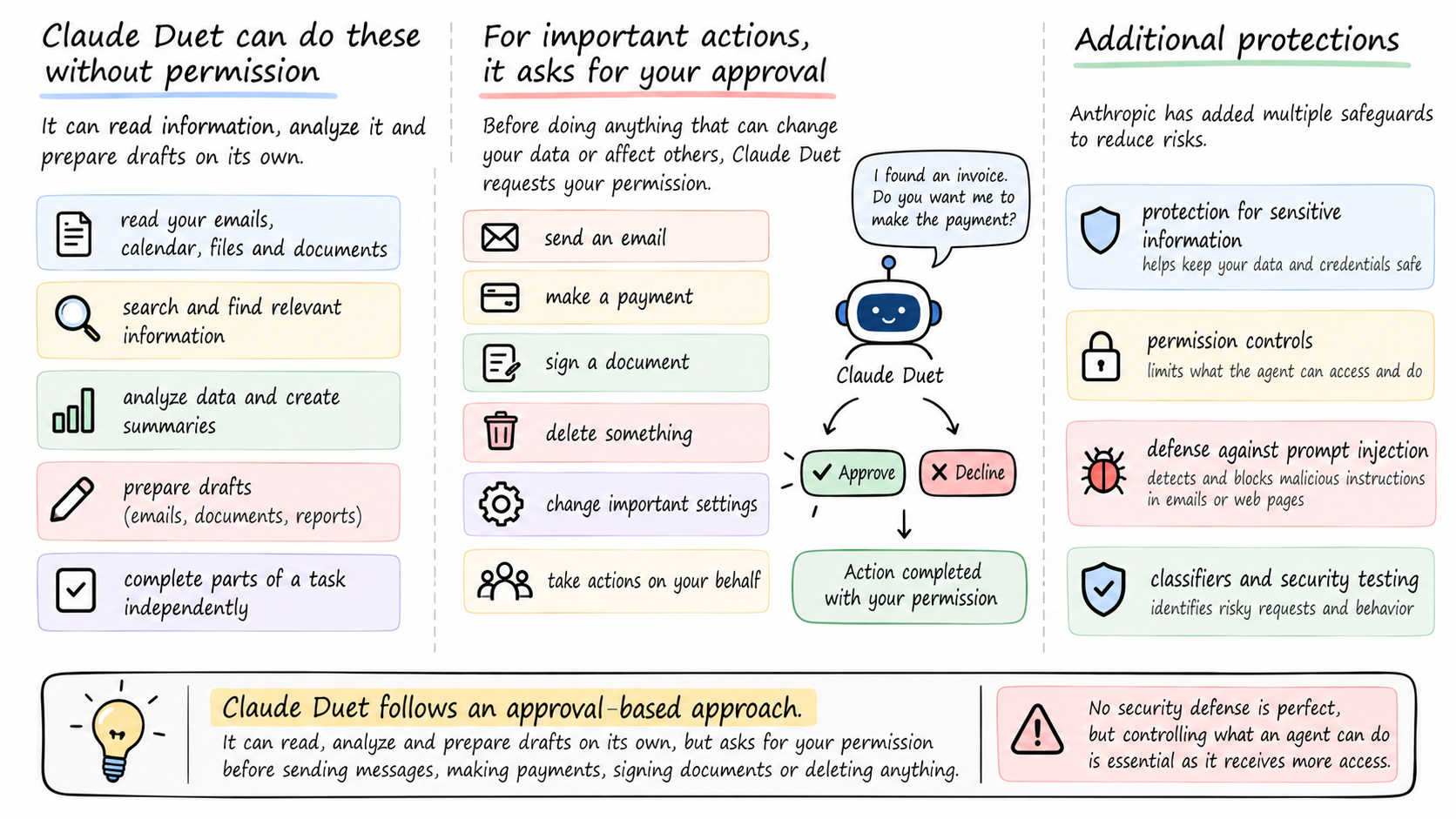
Anthropic has designed Duet around an approval-based approach.
It can read information, prepare drafts, and complete parts of a task independently. But before sending a message, making a payment, signing a document, or deleting something, it asks for your approval.
Anthropic has also introduced additional protections around sensitive information, credentials, and malicious instructions hidden inside emails or web pages. The latter is commonly known as prompt injection, where external content attempts to manipulate an AI agent into doing something its user did not request.
Importantly, Anthropic acknowledges that no security defense is perfect. The company has published a separate explanation of Duet's safety, privacy, and security design, including its use of classifiers, permission controls, and security testing.
This is the right direction for autonomous AI. The more access an agent receives, the more important it becomes to control what it can do.
7. Claude Duet vs. OpenAI Dots and other AI agents
Claude Duet is entering a market where several companies are trying to build AI systems that can work across applications rather than simply answer questions.
OpenAI's Dots, for example, are designed as ongoing personal agents that can remember context, use connected applications, and make progress between conversations.
Meta is also exploring proactive AI assistants through its Muse initiative.
The products are not identical, but they reflect a shared direction: AI is moving from isolated conversations toward systems that can manage ongoing tasks.
Claude Duet's approach puts particular emphasis on professional workflows, connected business applications, morning briefings, and approval-based execution.
Its support for more than 6,000 connectors also gives it a broad starting point for interacting with existing business software.
The real competition will not be decided by how impressive an agent looks in a demonstration. It will depend on whether it can consistently understand priorities, complete useful work, avoid mistakes, and earn enough trust for people to rely on it.
8. how to access Claude Duet and what does it cost?
As of October 30, 2026, Claude Duet is available as a research preview through a waitlist.
Anthropic has initially opened access to Claude Pro and Max subscribers in the United States. It is available through a standalone iOS and Android app and on the web at claude.ai.
There is no additional charge for Duet during the research preview. However, it shares the existing usage limits of your Claude subscription. Background activity and larger assignments also consume usage, so it can use your allowance differently from ordinary conversations.
There are some limitations worth understanding:
- It may occasionally misinterpret messages or misunderstand what is urgent.
- It checks connected accounts at intervals rather than monitoring everything continuously.
- Some personal tasks, such as booking tickets, are not yet its strongest use case.
- It cannot perform every action independently, even when you approve it.
Anthropic has also said that the research preview is an early version and that feedback from users will influence future development.
For now, users outside the United States cannot access the announced preview through the normal waitlist.
conclusion: the next AI assistant might not wait for you
Claude Duet represents an interesting change in how we interact with artificial intelligence. Instead of opening a chatbot every time we need help, we are moving toward agents that understand ongoing work, connect to our applications, and take responsibility for completing delegated tasks.
The technology is still early. There are questions about privacy, reliability, permissions, and how much autonomy people should give an AI system. But the direction is becoming clearer.
The next generation of AI products will not compete only on how intelligent their models are. They will compete on how much useful work they can complete without requiring constant human attention.
And perhaps that is the biggest shift of all.
"The most useful AI will not be the one that gives you the fastest answer. It will be the one that knows which work you should never have had to do yourself."