
The AI Revolution: How Artificial Intelligence Is Reshaping the World
Artificial intelligence is no longer something we only see in science fiction. It is writing code, helping doctors analyze medical information, changing how students learn, and giving small teams tools that once required entire departments.
The interesting part is not that machines can perform these tasks. It is how quickly they are becoming part of everyday life.
According to Stanford University's 2026 AI Index, generative AI reached an estimated 53% population adoption within three years of its introduction, spreading faster than personal computers or the internet did at comparable stages. Stanford AI Index 2026.
The AI revolution is already happening. But its biggest consequences may have less to do with the technology itself and more to do with how people choose to use it.
1. what is the AI revolution?
Every major technological shift changes what people can accomplish with their time. Artificial intelligence is changing not just how quickly we work, but also which tasks we can delegate to machines.
Traditional software follows instructions written by developers. Modern AI systems can also interpret natural language, recognize patterns, generate content, analyze information, and assist with complex tasks. Some AI agents can use tools and interact with software to complete multiple steps toward a goal.
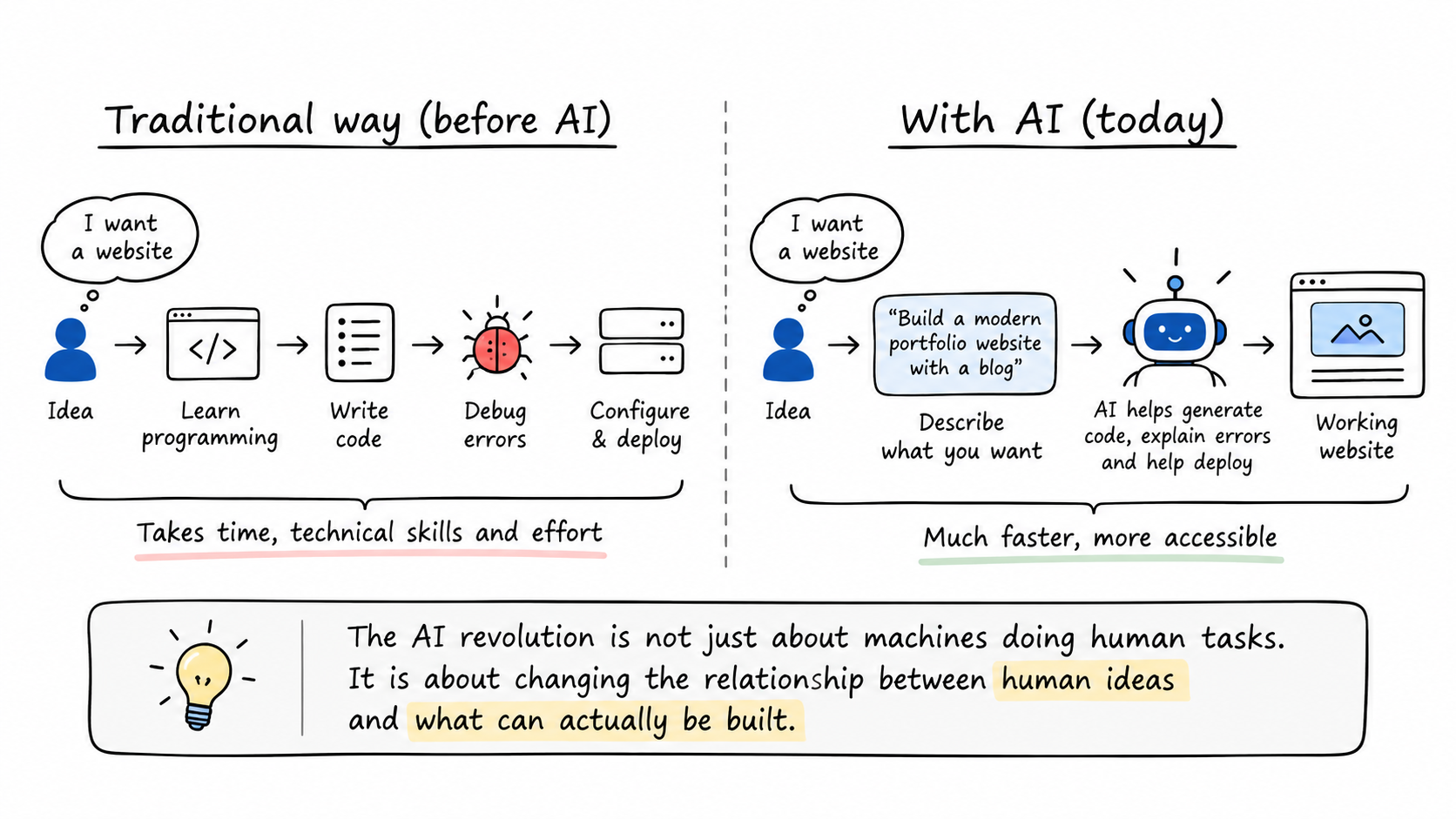
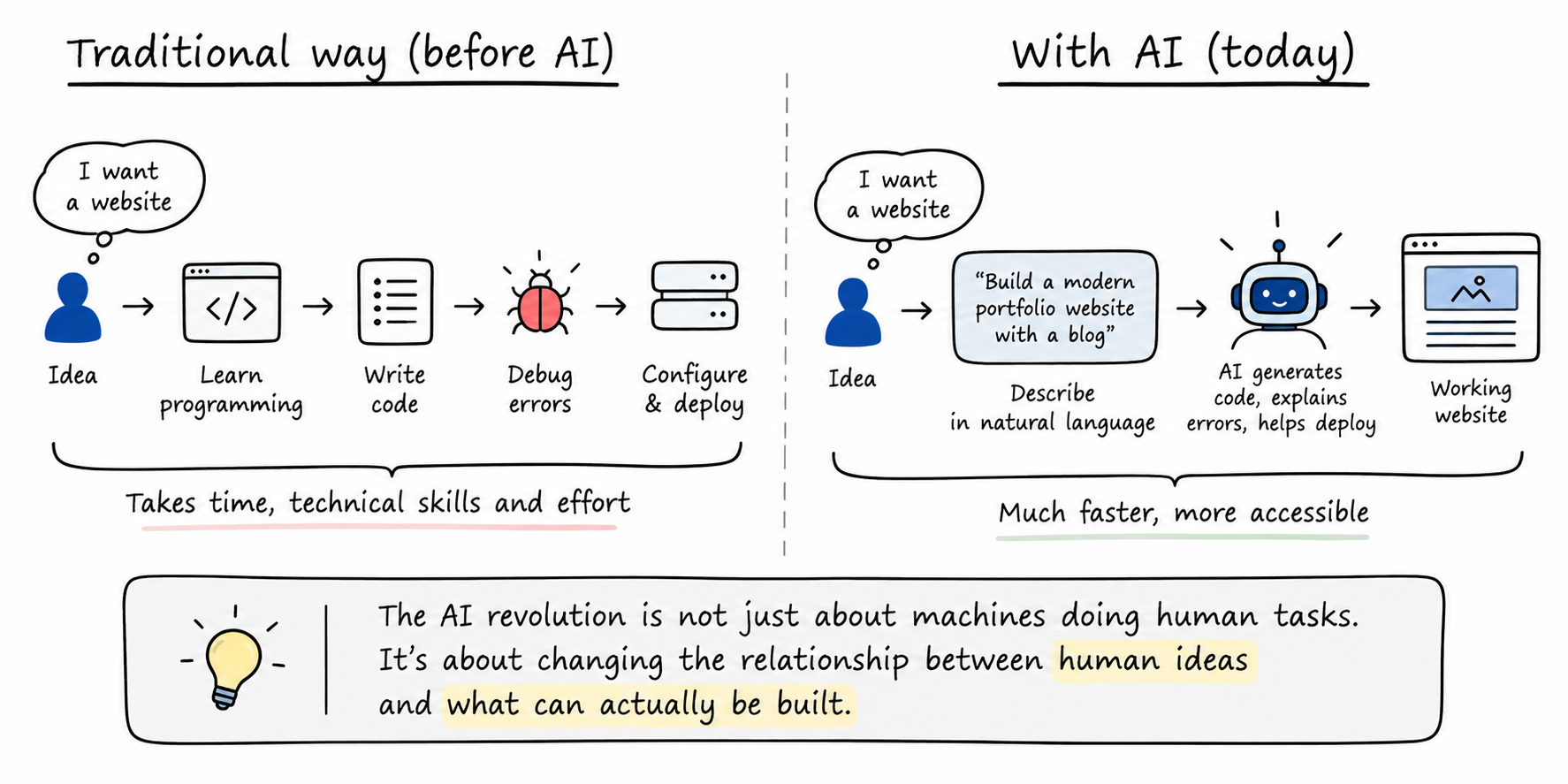
Think about building a website. Previously, you might have needed to learn programming, write the code, debug errors, and configure the application yourself. Today, you can describe the website you want and use an AI coding tool to generate a starting point, explain errors, and help you deploy it.
That does not eliminate the need for technical understanding. It changes where that understanding becomes most valuable.
The AI revolution is not simply about machines doing human tasks. It is about changing the relationship between human ideas and what can actually be built.
2. how AI is transforming software development
Software development is one of the clearest examples of this shift because AI can assist throughout the engineering process.
AI coding assistants can generate functions, explain unfamiliar code, suggest fixes, write tests, and help developers understand large codebases. AI agents can go further by editing files, running commands, and iterating on changes based on test results.
This creates new possibilities for experienced developers and beginners alike. A solo developer can experiment with ideas that once required a larger team. A startup can build an early prototype faster. An engineer can spend less time on repetitive implementation and more time considering architecture, security, and product behavior.
But generating code is not the same as producing reliable software. AI-generated changes can contain bugs, insecure assumptions, or unnecessary complexity. Human review, testing, and monitoring remain essential.
The deeper shift is toward AI-native engineering, where AI becomes part of the entire development workflow rather than a tool used only to write code.
The advantage will not necessarily belong to the person who generates the most code. It may belong to the person who can turn generated code into something people can depend on.
3. how AI is changing healthcare and scientific research
In healthcare, time and accuracy can have enormous consequences. AI is helping researchers and medical professionals analyze information that would otherwise require significant human effort.
Depending on the application, AI systems can assist with medical image analysis, identifying patterns in patient data, supporting clinical documentation, and accelerating aspects of drug discovery. Researchers also use AI to explore scientific questions, analyze large datasets, and develop hypotheses worth investigating.
The World Health Organization recognizes the potential of AI to improve diagnosis, treatment, health research, and drug development. It also emphasizes that ethical considerations and human rights must remain central to how these systems are designed and used. WHO guidance on AI in health.
That distinction matters because healthcare is not a field where a confident answer is automatically a correct answer. Medical data can be incomplete, models can produce misleading results, and systems may perform differently across patient populations.
AI can help professionals see patterns and process information, but medical decisions require appropriate clinical judgment, validation, and accountability.
The most valuable healthcare applications will not simply replace a human decision-maker with a machine. They will help people make better-informed decisions while keeping patient safety at the center.
4. how AI is transforming education and learning
Education has traditionally been organized around a teacher explaining concepts to many students at once. AI makes a more personalized learning experience possible.
A student struggling with algorithms can ask an AI tutor to explain recursion using a simple example, generate practice questions, or identify mistakes in a solution. Someone learning a new language can practice conversations. A developer can ask for an explanation of an unfamiliar programming concept and then work through examples.
This can make learning more accessible, especially for people who cannot afford private tutoring or do not have easy access to expert guidance.
However, there is a difference between using AI to understand something and using it to avoid learning altogether. A student who copies generated answers may finish an assignment without developing the skills the assignment was supposed to teach.
Schools and universities must also adapt their assessments, academic integrity policies, and teaching methods to a world where AI assistance is widely available.
The real opportunity is to make learning more interactive, not to remove the effort that makes learning effective.
AI can give people answers in seconds. Education still needs to teach them how to ask better questions, evaluate those answers, and think independently.
5. how AI is changing jobs and the global economy
Few questions about AI generate as much anxiety as the future of work.
AI can automate parts of many jobs, including writing reports, summarizing documents, processing routine requests, generating code, and analyzing information. Businesses may use it to increase productivity, reduce repetitive work, or provide services that were previously too expensive.
But the impact on employment is more complicated than a simple prediction that AI will eliminate every job it touches.
Some tasks may disappear, some roles may change, and new opportunities may emerge. The outcome will vary by industry, region, organization, and the speed at which workers can adapt. Stanford's 2026 AI Index examines these economic changes alongside AI adoption, investment, and workforce trends.
For individuals, this means that learning new skills matters, but simply collecting AI tools is not enough. Understanding a field, solving meaningful problems, communicating clearly, and checking the quality of AI-generated work can all become valuable advantages.
For businesses, productivity gains will depend on more than purchasing an AI subscription. Teams need to redesign workflows, protect sensitive information, and measure whether the technology actually improves outcomes.
The future of work will not be determined by AI capability alone. It will also depend on the decisions organizations and societies make about how that capability is used.
6. how AI is changing everyday life and business
The AI revolution is not limited to laboratories or technology companies. It is increasingly visible in ordinary activities.
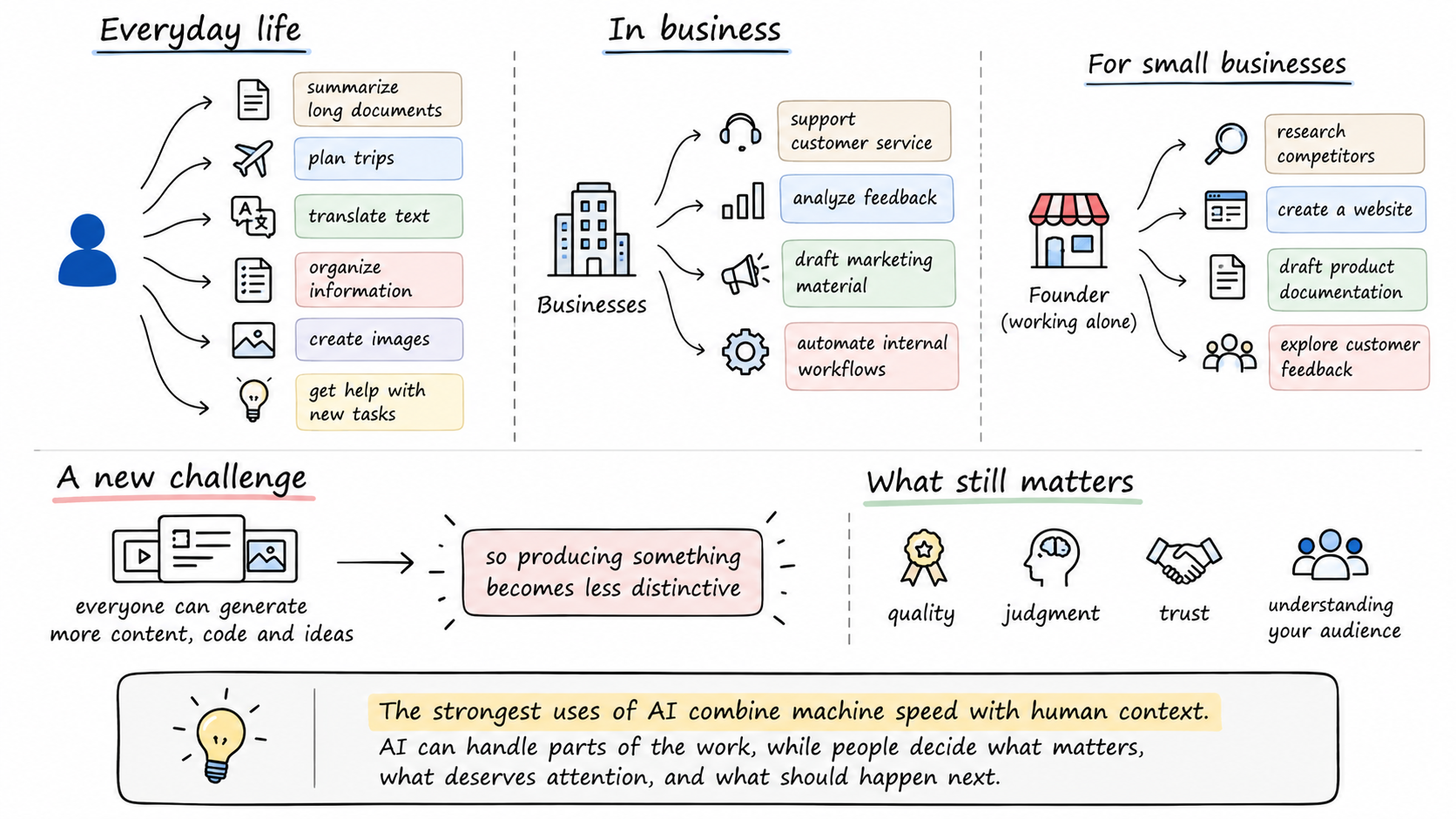
People use AI to summarize long documents, plan trips, translate text, organize information, create images, and get help with unfamiliar tasks. Businesses use it to support customer service, analyze feedback, draft marketing material, and automate parts of internal workflows.
Small businesses may benefit particularly from these tools. A founder working alone can use AI to research competitors, create an initial website, draft product documentation, and explore customer feedback without hiring a specialist for every task.
Yet easier production also creates a new problem: when everyone can generate more content, code, and ideas, producing something becomes less distinctive.
Quality, judgment, trust, and a genuine understanding of the audience become more important. AI can help a business produce a hundred marketing messages, but it cannot guarantee that any of them will resonate with customers.
The strongest uses of AI often combine machine speed with human context. AI handles parts of the work, while people decide what matters, what deserves attention, and what should happen next.
7. the risks we cannot afford to ignore
Every powerful technology introduces new opportunities and new ways to cause harm. AI is no exception.
AI systems can generate false information that sounds convincing, reproduce biases present in their training data, expose sensitive information through careless use, and make it easier to create misleading images or impersonations. Automated decisions can also affect people unfairly when systems are poorly tested or deployed without appropriate oversight.
Security creates another challenge. An AI agent with access to files, accounts, databases, or production systems can do useful work, but excessive permissions can turn a mistake into a serious incident.
There are also wider concerns about who benefits from AI. Access to computing infrastructure, reliable internet, education, and advanced tools remains unequal. If the benefits concentrate among a small number of companies or countries, the technology could deepen existing economic gaps.
These risks do not mean AI development should stop. They mean progress must include safety testing, transparency, privacy protections, meaningful human oversight, and clear responsibility when something goes wrong.
The 2026 Stanford AI Index highlights a growing gap between advancing AI capabilities and the systems needed to evaluate and govern them.
A technology becomes truly powerful when people can trust it. Building that trust requires more than making models smarter.
8. what comes next in the AI revolution?
The next stage of AI will likely involve systems that do more than respond to individual prompts. AI agents are increasingly designed to plan tasks, use software tools, work across multiple steps, and check their own progress against a goal.
Imagine describing a software feature and having an agent inspect the codebase, implement the change, run tests, and prepare a deployment for review. Or imagine a researcher using AI to search scientific literature, analyze results, and identify promising directions for further experiments.
These possibilities could change how teams work and how quickly ideas move from conception to implementation. But greater autonomy also makes permissions, verification, and recovery mechanisms more important.
The future will not be shaped by technical capability alone. It will depend on how well people integrate AI into existing systems, how institutions respond to changing demands, and whether the benefits reach beyond those who already have access to powerful technology.
For individuals, the practical response is to stay curious, experiment responsibly, and build a deeper understanding of the work they want AI to help them do.
For organizations, the challenge is to move beyond demonstrations and build systems that produce measurable, reliable results.
conclusion: the future is being built through our choices
The AI revolution is changing software development, healthcare, education, business, and the way people interact with information. Its potential is enormous, but its outcomes are not guaranteed.
AI can make expertise more accessible, reduce repetitive work, and help people explore ideas that once seemed out of reach. It can also amplify mistakes, create new security risks, and distribute opportunities unevenly.
The important question is no longer whether artificial intelligence will influence our lives. It already does. The more difficult question is whether we will learn to use it thoughtfully, build safeguards around it, and ensure its benefits are shared widely.
Technology may determine what becomes possible. Human choices will help determine what becomes normal.
"The future will not belong to those who simply have access to intelligence, but to those who learn what to do with it."