
An AI coding agent can write a feature, run commands, inspect files, and fix bugs. But what makes it capable of doing all those things reliably instead of simply generating code and hoping for the best?
The answer is not just a smarter model. It is the system around that model.
That system is called an AI agent harness, and it is becoming an important concept in AI-native engineering. Understanding it explains why two coding agents using similar models can behave very differently, and why reliable AI development requires much more than a good prompt.
1. what is an AI agent harness?
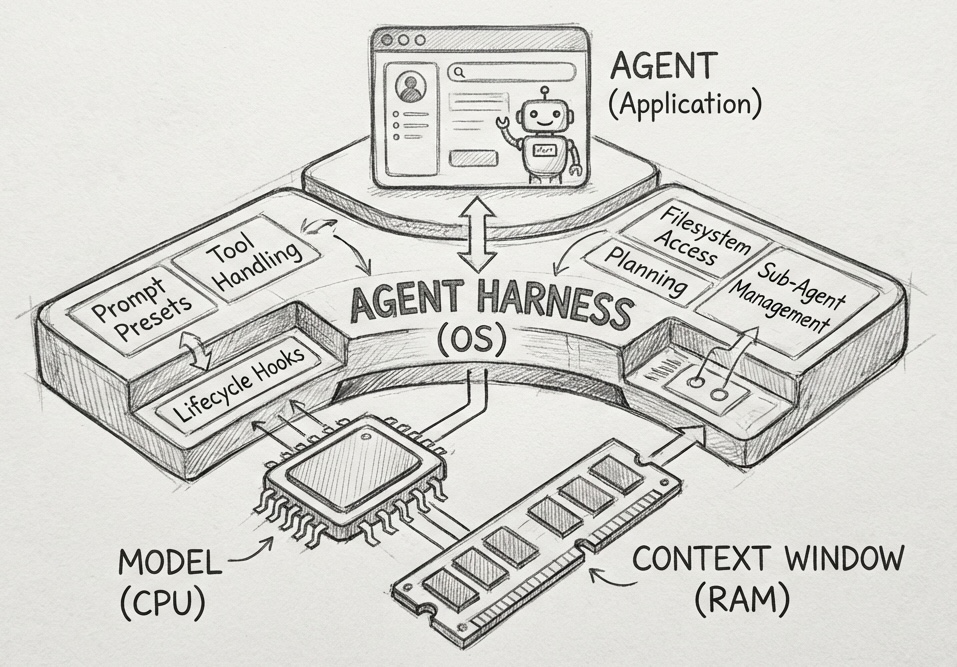
An AI agent harness is the software layer that connects a language model to the tools, context, execution environment, and feedback it needs to perform tasks.
A language model generates responses and can request actions. By itself, it does not automatically have access to your repository, terminal, database, or development environment. The harness coordinates those capabilities and manages the process of carrying out the model's decisions.
Microsoft's Agent Framework documentation describes a harness as the runtime scaffolding that coordinates model calls, tools, conversation state, and approval policies.
Think of the model as the reasoning engine and the harness as the system that allows it to do useful work.
The model generates decisions. The harness turns those decisions into a working process.
2. how does an AI agent harness work?
Imagine asking an AI coding agent to fix a failing test in your React application.
The agent needs to understand the error, find the relevant code, make a change, execute the test, and determine whether the problem is solved. A harness coordinates that process.
A typical workflow looks like this:
- Receive the task: The harness collects your instructions and relevant session context.
- Prepare context: It supplies the model with available tools, project information, and the current task.
- Execute actions: The model requests actions such as reading files, editing code, or running tests.
- Collect results: The harness executes permitted tool calls and returns their outputs to the model.
- Continue or finish: The model uses the results to decide whether to investigate further, revise the code, or report completion.
This cycle can repeat several times.
The important detail is that the agent can respond to actual results rather than relying entirely on its initial prediction. If a test fails, the failure becomes new information that can guide the next attempt.
That is how a simple request can become a multi-step engineering workflow.
3. what are the main components of an agent harness?
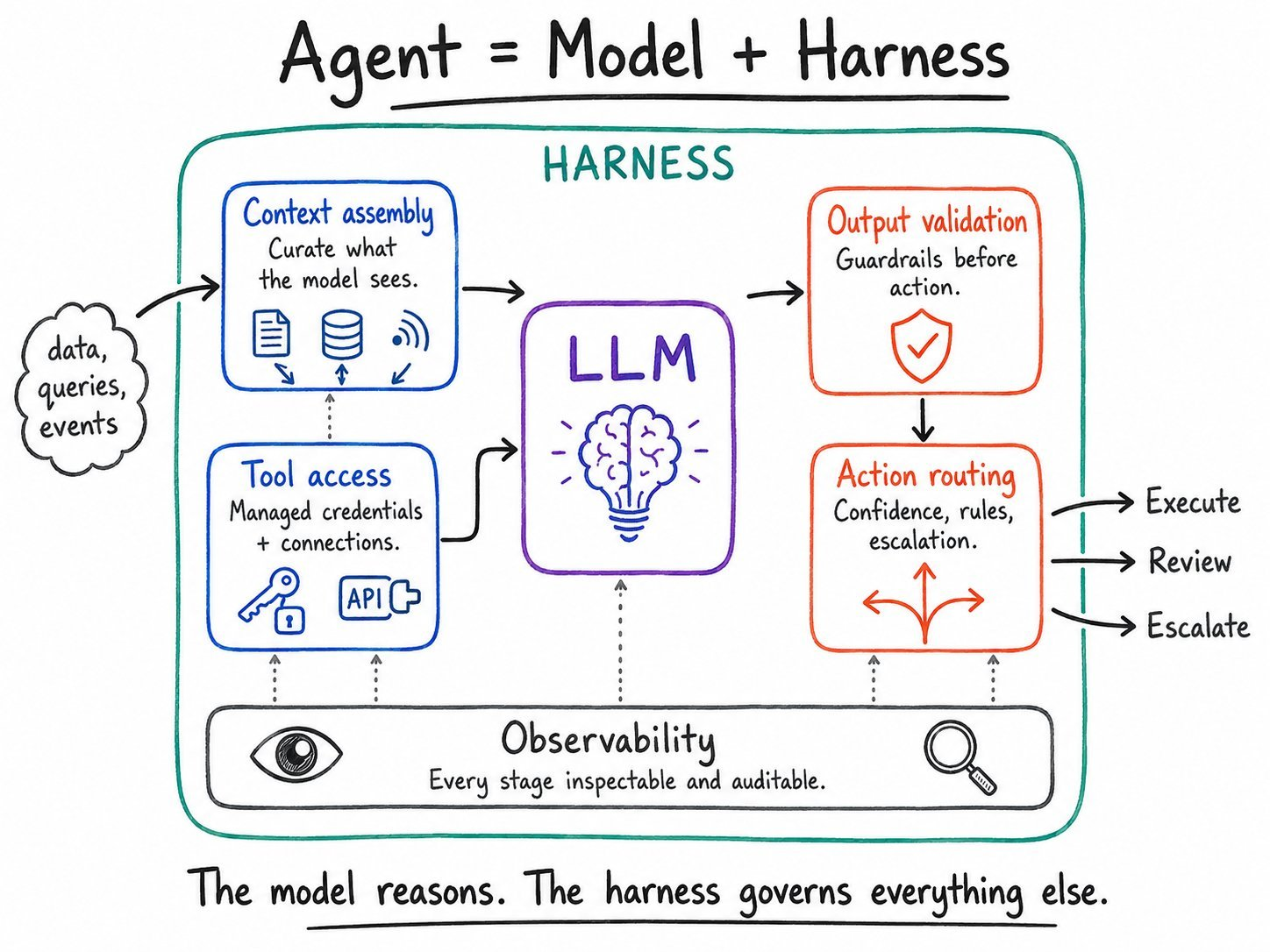
A reliable harness typically combines several capabilities, although the exact architecture varies between implementations.
- Context management: Supplies relevant instructions, conversation history, and project information.
- Tool execution: Connects the model to file operations, terminals, code search, APIs, and other capabilities.
- State management: Tracks the task, previous actions, tool results, and progress across multiple steps.
- Permissions and approvals: Controls which actions can happen automatically and which require human confirmation.
- Feedback and verification: Returns test results, command output, errors, and other evidence to the model.
- Observability: Records relevant activity so developers can understand what the agent did and investigate failures.
These components work together. Tools without useful context can lead to misguided actions. Context without execution tools limits what an agent can accomplish. Execution without appropriate permissions creates unnecessary risk.
The goal is to build a system in which the agent has enough capability to make progress, enough information to make informed decisions, and enough constraints to work safely.
4. what is the difference between a model, an agent, a harness, and a framework?
These terms are related, but they describe different parts of the system.
| Concept | What it does |
|---|---|
| AI model | Processes information and generates responses or action requests |
| AI agent | Uses a model and available capabilities to pursue a goal |
| Agent harness | Coordinates the model, tools, state, permissions, and execution loop |
| Agent framework | Provides reusable building blocks for developing agent applications |
| Execution environment | Provides the place where code runs and files or commands can be accessed |
For example, a coding agent might use a language model to reason about a bug, a harness to coordinate file edits and test execution, and a container to run the application safely.
An agent framework may provide components for building that system, but it is not necessarily the same thing as the running harness.
The boundaries can overlap depending on the product. Some tools bundle several of these responsibilities together, while others separate them into distinct services.
Microsoft's harness documentation and OpenAI's Agents API architecture guide explain these distinctions from different implementation perspectives.
5. why does harness engineering matter for AI coding agents?
A capable model can still struggle when it lacks the tools, constraints, or feedback needed to complete a task.
Consider an agent asked to add authentication to an application. It might generate a working login form but miss server-side authorization, overlook existing session handling, or fail to run the relevant tests.
A better harness can make the correct workflow easier to follow. It can expose project instructions, provide access to test commands, restrict dangerous operations, and return failures so the agent can investigate them.
OpenAI explored this idea in its February 2026 article, Harness Engineering: Leveraging Codex in an Agent-First World. The team described building an environment where agents could work through repository tools, architectural constraints, automated checks, and feedback loops.
The central lesson was that reliability does not come from asking an agent to try harder every time it fails. Often, the better solution is to improve the environment so the same failure becomes easier to detect or harder to repeat.
6. how to build a reliable coding agent harness
You do not need to build a complicated autonomous platform to apply harness engineering. Start with the capabilities that address your biggest problems.
Give the agent useful context. Include accurate repository instructions, relevant files, and clear task requirements. Avoid flooding every task with unrelated documentation.
Expose the right tools. Let the agent search code, edit files, and run appropriate tests. Give it only the capabilities required for its work.
Add verification. Use automated tests, type checking, linting, and other project checks to evaluate changes. Do not treat the agent's claim that a task is complete as proof.
Set clear permission boundaries. Use restricted environments for potentially destructive commands and require approval for sensitive actions when appropriate.
Keep a record of failures. If an agent repeatedly makes the same mistake, improve the instructions, tools, or automated checks instead of relying on another corrective prompt.
Measure actual outcomes. Track whether tasks are completed correctly, how often changes fail review, and whether the agent introduces regressions. More generated code does not necessarily mean better results.
These practices create a foundation that can improve as the application and its engineering requirements grow.
7. are AI agent harnesses the future of AI-native engineering?
Harnesses are becoming an important part of AI-native engineering because they address a problem that better models alone cannot solve: turning model capabilities into dependable actions inside real systems.
As coding agents become more capable, the surrounding infrastructure must help them manage context, interact with tools, recover from failures, and operate within clear boundaries.
That does not mean every developer needs to create a custom harness. Existing coding tools already provide many of these capabilities. The useful skill is understanding what happens behind the interface and recognizing which limitations come from the model, the tools, or the environment.
The future of AI-native engineering will depend on the quality of that entire system, not simply the intelligence of the model at its center.
8. the real engineering advantage
An AI coding agent is not reliable simply because it can write good code. It becomes useful when it can access the right information, take appropriate actions, observe what happens, and correct its mistakes.
That is the purpose of a harness.
For developers, understanding this concept changes the question from "Which model writes the best code?" to "Which system helps the model complete real engineering tasks reliably?"
The answer depends on context, tools, verification, permissions, and the quality of the surrounding workflow. A better model can help, but the system around it determines how effectively its capabilities translate into useful work.
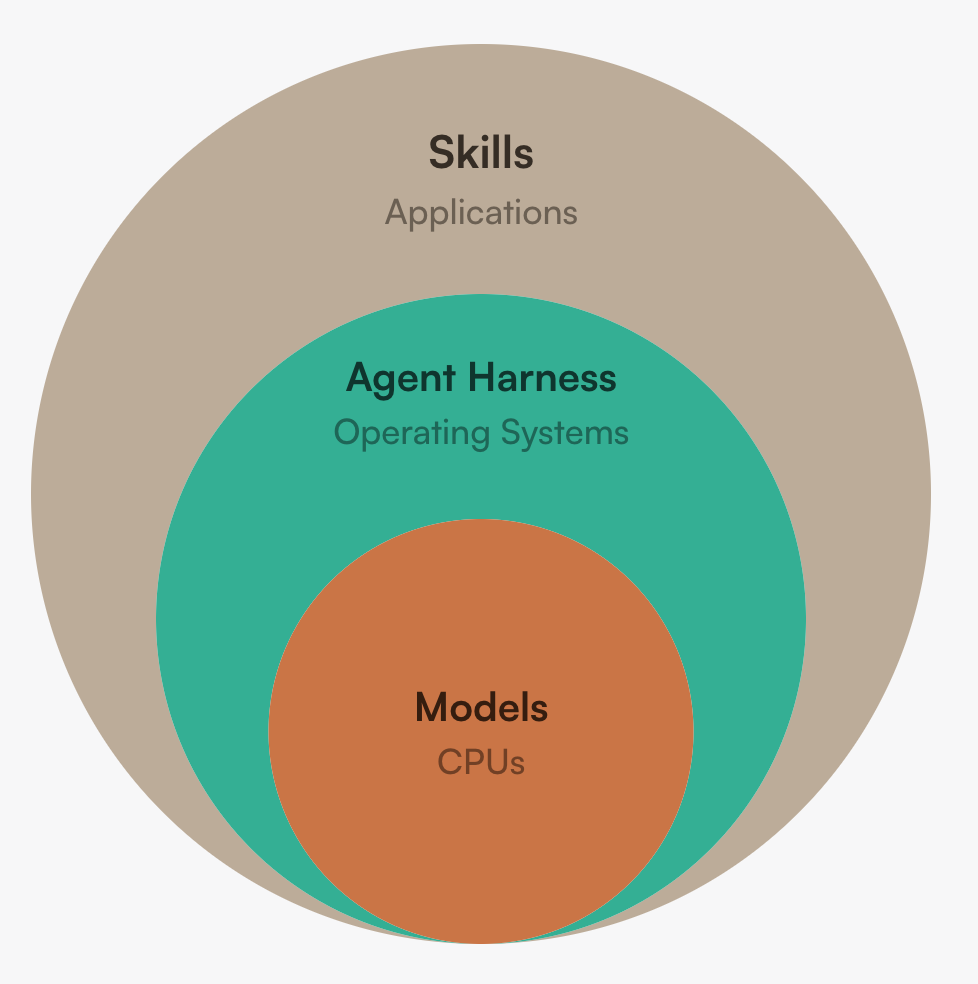
The model is the intelligence. The harness is what helps that intelligence become dependable engineering.