
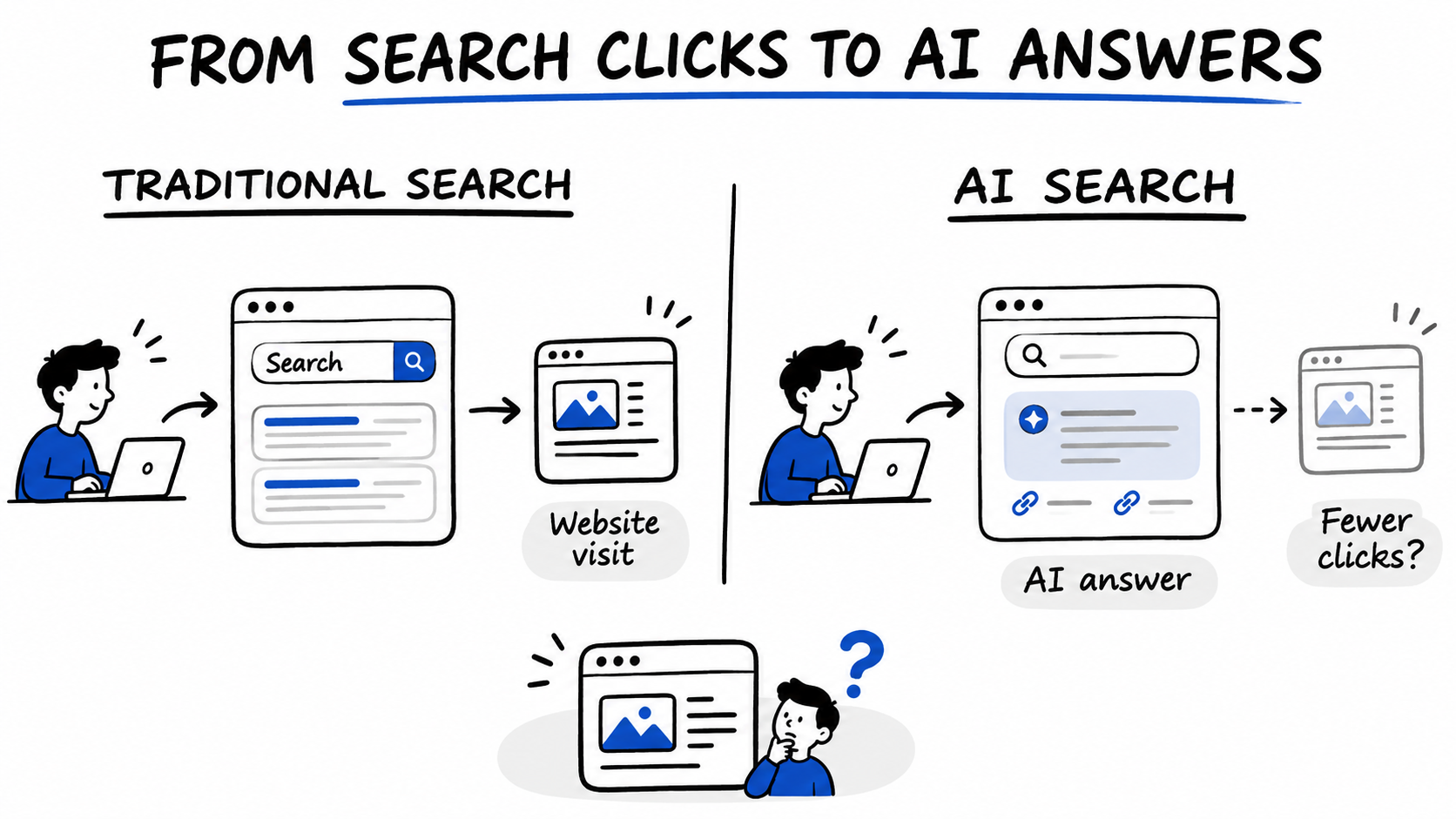
For years, the internet worked on a simple exchange.
People searched on Google, discovered websites, clicked links, and visited the pages that contained the information they needed. Publishers created content, Google sent visitors, and businesses earned revenue through advertising, subscriptions, or products.
Now that exchange is changing.
Search for a technical explanation, a product comparison, or a question about a particular topic, and Google might answer you before you visit a single website.
Its AI can summarize information, combine answers from multiple sources, and display links alongside the generated response. You get what you were looking for without necessarily leaving Google.
For users, this can be convenient. For publishers, bloggers, independent creators, and businesses that depend on organic search traffic, it raises a difficult question:
If Google can answer the question itself, why would anyone visit the website that originally published the answer?
1. how Google AI Search is changing the internet
Google Search was traditionally designed to help people discover information across the web. You entered a query, received a list of results, and decided which website to visit.
That experience is changing through two major features: AI Overviews and AI Mode.
AI Overviews provide AI-generated summaries directly within traditional search results. They help users understand a topic without necessarily opening several websites.
AI Mode takes the experience further. It provides a conversational search interface where users can ask complex questions, explore follow-ups, and receive synthesized answers.
Imagine searching for "best database for a SaaS application."
Previously, you might have opened five articles comparing PostgreSQL, MongoDB, MySQL, and other databases. You would read their advantages, disadvantages, and recommendations before making a decision.
Now, Google's AI can summarize those differences directly in the search experience.
You can ask follow-up questions and explore related topics without visiting every source.
Google says these features help users discover information more efficiently and create additional opportunities for websites to appear in AI-generated experiences. But the way people interact with search results is clearly changing.
2. what are zero-click searches, and why should website owners care?
One of the biggest challenges for publishers is the rise of zero-click searches.
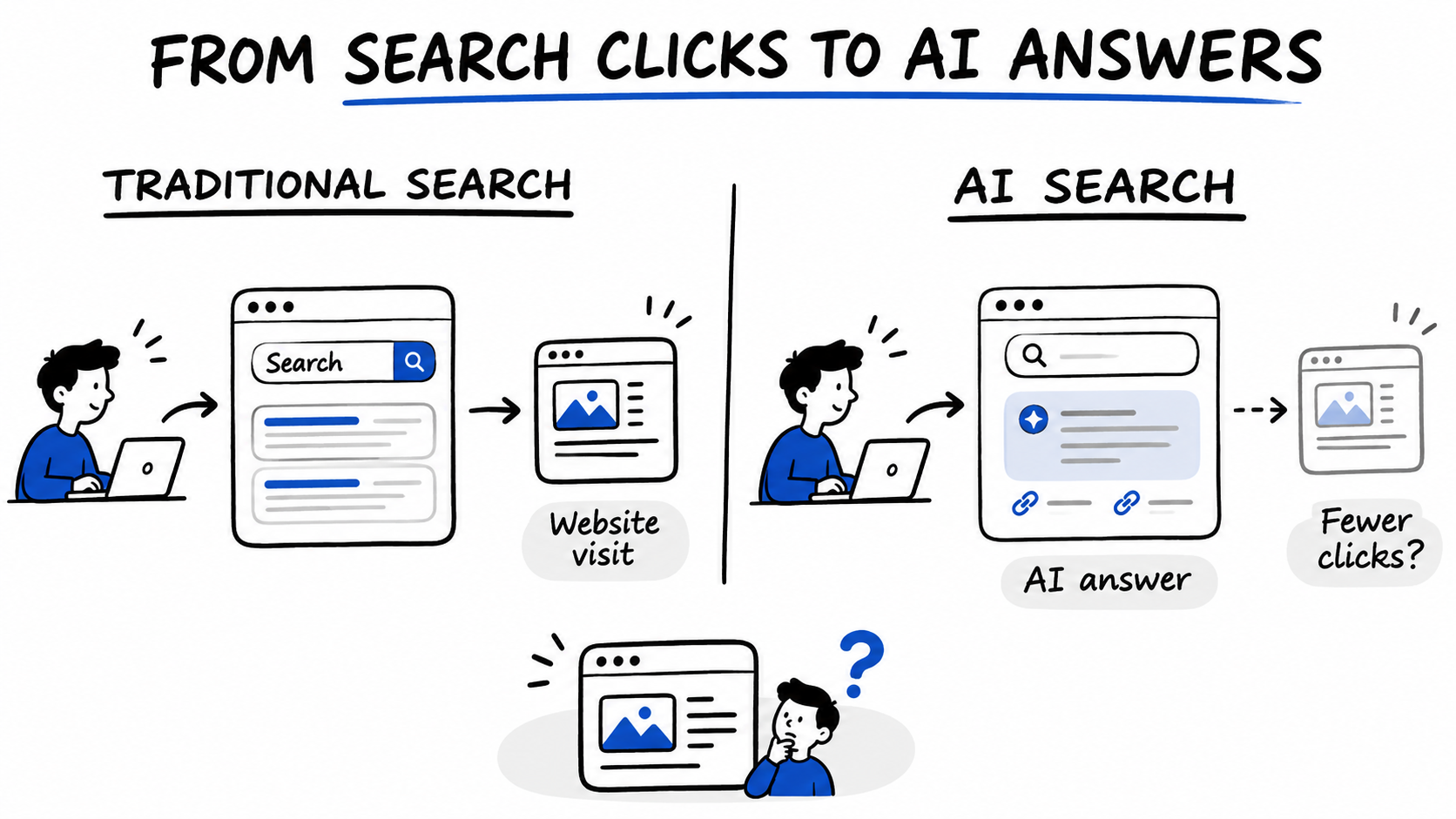
A zero-click search happens when someone searches for something but does not click through to an external website.
Consider a simple example.
Someone searches for "What is the capital of Japan?" Google displays the answer immediately. The user gets the information and leaves without visiting an external source.
This behavior existed before generative AI. Google already displayed featured snippets, weather information, knowledge panels, sports scores, and other direct answers.
AI Overviews expand this experience to more complicated questions.
The consequences become more significant when a website publishes content specifically designed to answer informational searches.
A blog might spend several hours researching and writing an article explaining how a technology works. Google can potentially summarize the main points directly on its results page.
The user gets the answer. The website receives no visit.
Research from SparkToro and Similarweb estimated that 68.01% of Google searches in the United States ended without an external click during the first four months of 2026. This figure includes several reasons for searches ending without an external visit, not just AI Overviews.
The important distinction is that a search impression does not guarantee a website visit.
3. are Google AI Overviews actually reducing website traffic?
There is now experimental research examining this question rather than relying entirely on speculation.
A 2026 field experiment conducted by researchers associated with the Indian School of Business and Carnegie Mellon University examined how Google's AI Overviews affected user behavior.
The researchers randomly assigned users to search experiences with and without AI Overviews. Their findings were significant.
When AI Overviews appeared, outbound organic clicks decreased by approximately 39.8%, while zero-click searches increased by 34.5%.
The study also found that engagement on external websites, conditional on someone actually clicking through, was not measurably different between the groups.
In other words, the presence of AI-generated answers reduced the number of people visiting external websites in the experiment.
Another experiment involving 1,100 Google users examined AI Mode. Researchers found that directing participants into an AI Mode experience reduced the share of searches resulting in an external website visit by 18.8 percentage points compared with regular Google Search.
These findings provide evidence that AI-powered search experiences can reduce publisher referrals.
However, they should not be interpreted as proof that every website has lost 40% of its traffic. The results depend on the experiment, the queries, the search experience, and the population being studied.
The effect also varies between informational searches, product searches, breaking news, and searches where users specifically want to visit a particular website.
4. why are publishers and independent websites worried?
For many years, Google organic search was one of the most important distribution channels for online publishers.
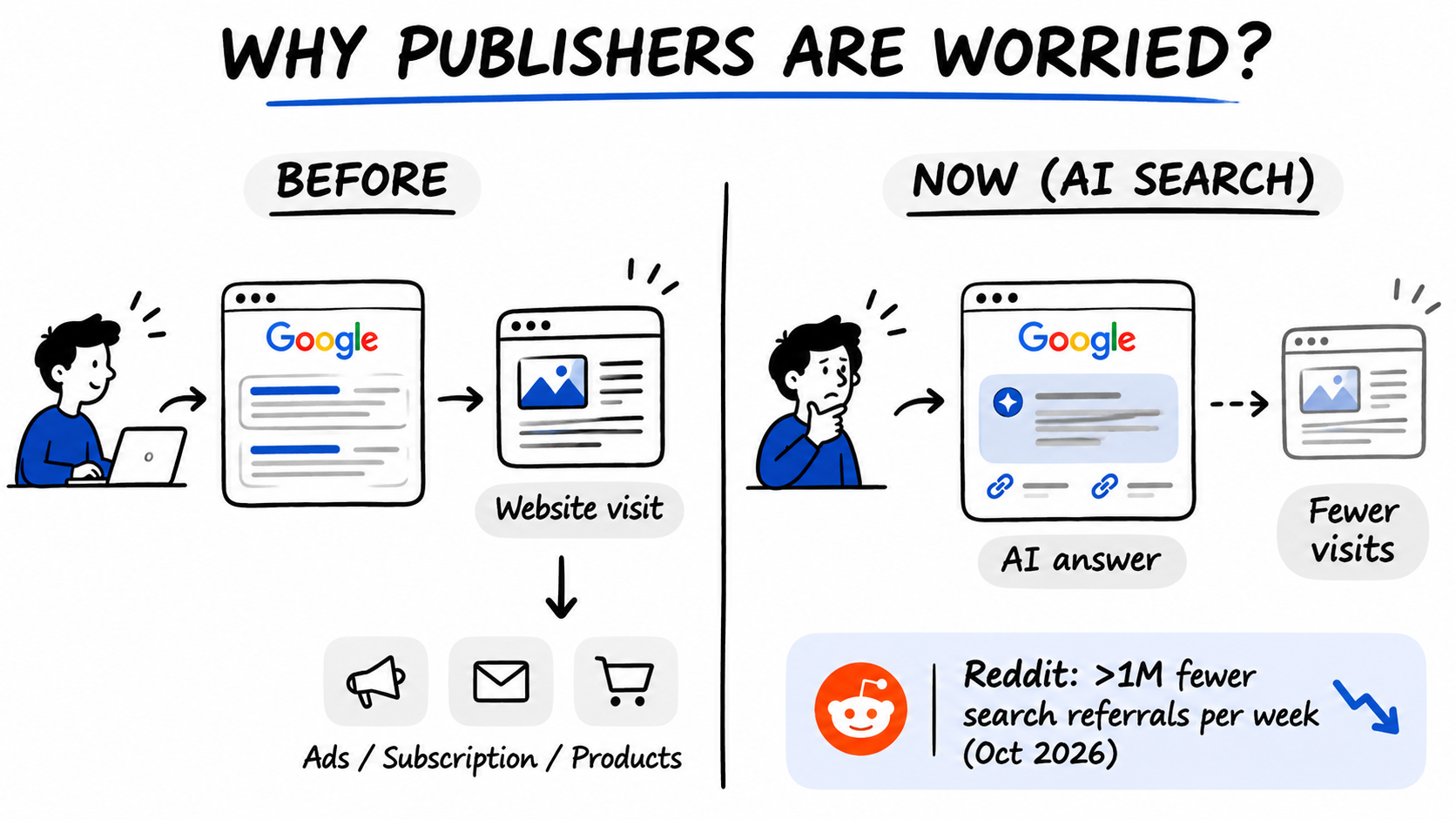
A website could publish useful articles, rank for relevant keywords, attract visitors, and generate revenue through advertising, subscriptions, affiliate links, or product sales.
AI search introduces a problem into that business model.
Imagine an independent technology blog that publishes 100 articles about programming, software development, and AI tools.
Previously, people searching for those topics might visit the website to read its explanations. Each visit created an opportunity to discover other articles, subscribe to a newsletter, or explore a product.
Now, if Google provides enough information directly in an AI-generated answer, some users may never visit the original article.
The website might still appear as a cited source, but being mentioned and receiving a meaningful number of visitors are two different things.
This concern is not limited to small blogs.
On October 29, 2026, Reddit CEO Steve Huffman discussed declining Google search referrals and said Reddit had received more than one million fewer search referrals per week on average during October.
He attributed the decline partly to Google's AI search experiences, which can answer questions without sending users to Reddit discussions.
This illustrates a larger problem: websites can continue supplying useful information to search engines while receiving fewer visitors in return.
5. is Google taking information from websites without sending traffic back?
This is where the debate becomes more complicated.
AI search systems rely on information from the wider web. They retrieve, process, and summarize information from sources that help construct their answers.
Publishers argue that their content creates value for search engines and AI systems, but they need visitors to sustain the businesses that produce that content.
Google has defended its approach.
In August 2025, Google said it continued to send billions of clicks to websites every day and that overall organic click volume had remained relatively stable year over year according to its internal data.
Google also argued that AI features create opportunities for websites to appear in new types of searches and receive more qualified clicks from users who want to explore a subject in greater depth.
These claims represent Google's aggregate view of its search traffic. They do not establish that every publisher or category has experienced stable traffic.
There is an important difference between two things:
- Google sending a large total number of clicks across the internet.
- A particular publisher receiving enough clicks to sustain its business.
Both can be true at the same time: overall traffic can remain relatively stable while specific websites, industries, and content categories experience significant losses.
The debate is therefore not simply about whether Google is sending clicks. It is about how the distribution of attention and economic value is changing.
6. which websites are most vulnerable to AI Search?
Not every website faces the same level of risk.
A website that publishes simple informational articles may be more exposed than one offering a service, interactive tool, or unique product.
Consider these examples.
Basic informational blogs: Articles answering straightforward questions can be summarized directly by AI search experiences. Users may have less reason to visit the original page.
Technology tutorials: Simple explanations and introductory guides can lose visits when AI provides sufficient instructions. However, detailed tutorials involving code, troubleshooting, and real-world examples can still attract people who need deeper guidance.
Product comparison websites: AI can summarize features, specifications, and differences between products. But users may still visit websites for independent reviews, hands-on testing, detailed comparisons, and purchasing information.
News publishers: AI summaries can reduce the need to open multiple articles for basic updates. Original reporting, exclusive information, analysis, and live coverage remain important reasons to visit publishers directly.
Community platforms: Websites such as Reddit contain personal experiences, discussions, and opinions that are difficult to reproduce fully in a short summary. But their search referral traffic can still be affected.
The common factor is the type of value a website provides.
If a page only repeats information that can easily be summarized, it faces a different challenge from a website offering original research, useful tools, expert experience, or something visitors cannot get from a generated answer alone.
7. what should website owners do to survive AI Search?
The old SEO approach focused heavily on ranking pages for keywords and attracting organic clicks.
Traditional SEO is still important, but website owners need to think more broadly about how people discover and interact with their content.
Here are some practical changes worth considering.
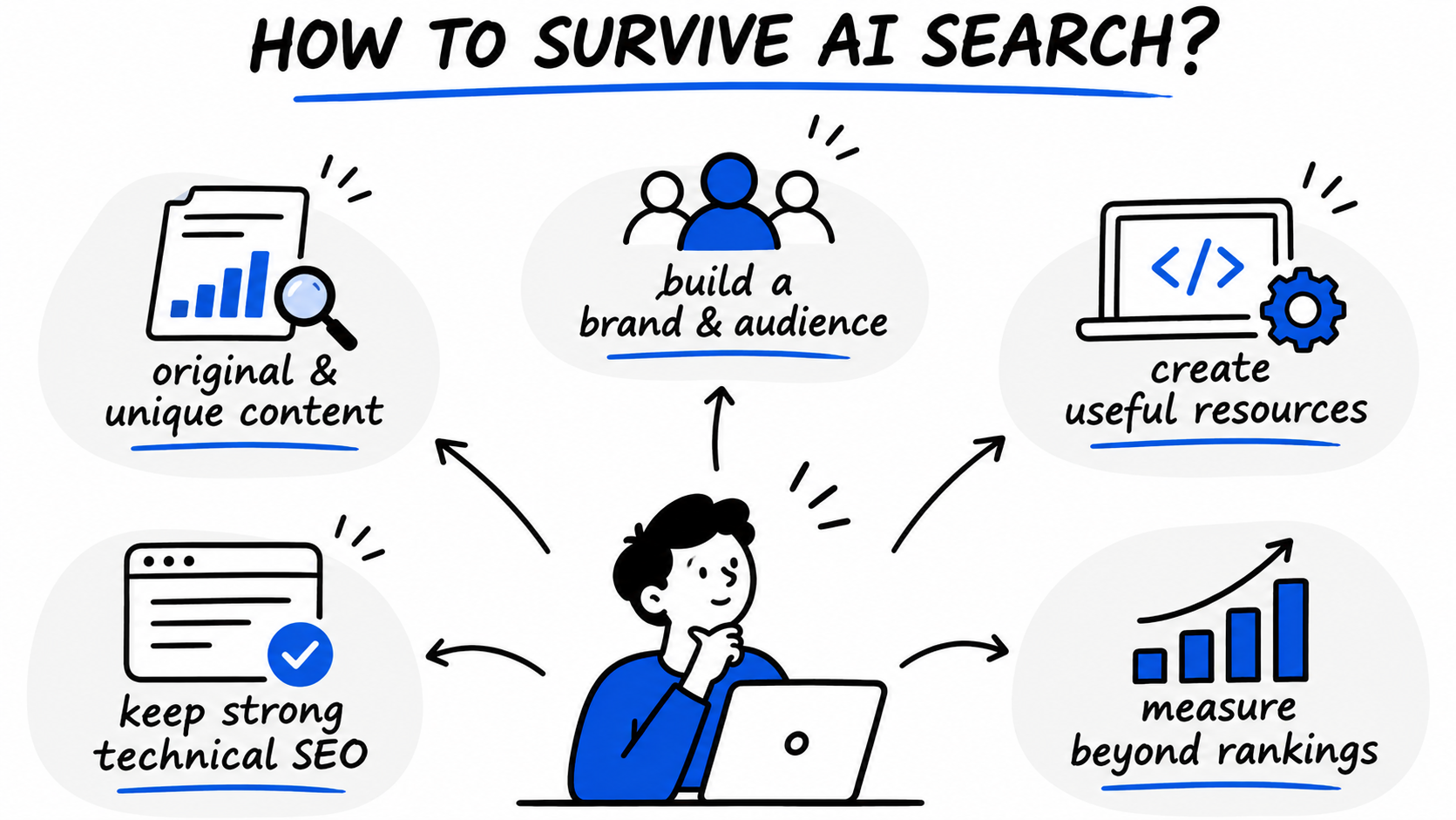
1. publish information that cannot easily be replaced by a summary.
Include original research, experiments, case studies, practical examples, real-world observations, and technical explanations. Give readers something beyond information they could obtain from a generic AI response.
2. build a recognizable brand.
People should have reasons to visit your website directly rather than discovering it only through Google. Build an email newsletter, community, social presence, and returning audience.
3. create useful resources.
Interactive calculators, downloadable templates, software tools, detailed documentation, and practical guides give users a reason to visit and engage with your website.
4. maintain strong technical SEO.
Make sure your pages can be crawled and indexed, your website performs well, and your content follows established search quality practices. Google says its existing SEO fundamentals remain relevant for AI Overviews and AI Mode.
5. measure more than rankings.
Track impressions, clicks, click-through rates, conversions, returning visitors, and revenue. A page can maintain its ranking while receiving fewer visits, so rankings alone do not tell the complete story.
6. diversify traffic sources.
Do not depend entirely on Google. Explore newsletters, social platforms, communities, partnerships, direct traffic, and other relevant discovery channels.
The objective is not to abandon SEO. It is to stop treating Google rankings as the only way people should discover your business.
8. what happens to the internet if nobody visits websites anymore?
This is perhaps the most important question behind the entire debate.
AI search depends on information created across the internet. Journalists investigate stories. Developers write documentation. Researchers publish findings. Independent creators test products and share their experiences.
That work requires time, money, and expertise.
If AI systems increasingly satisfy users without sending meaningful traffic to the sources that produce the information, the economics of publishing could change.
Some publishers may introduce subscriptions. Others may focus on direct audiences, licensing agreements, or exclusive content. Smaller websites that depend heavily on advertising could find it harder to sustain their operations.
There is also a potential feedback problem.
If fewer people visit original sources, publishers may have fewer resources to produce high-quality information. Over time, this could affect the quality and diversity of material available across the web.
This is not a guaranteed outcome, and different publishers will respond differently. Google is also introducing changes intended to make sources and links more visible in AI search experiences.
But the underlying question remains: how can an ecosystem built around creating and distributing information remain sustainable when the distribution model changes?
The internet needs more than systems that can summarize information. It needs people and organizations that continue producing reliable information in the first place.
conclusion: the future of search is also the future of publishing
Google AI Search is changing how people discover information, and the evidence increasingly shows that AI-generated answers can reduce visits to external websites for certain types of searches.
But the story is not as simple as Google replacing every website. Search behavior varies, some publishers continue receiving valuable traffic, and AI experiences can also introduce users to sources they might not otherwise discover.
What is changing is the relationship between information, discovery, and attention.
For website owners, the challenge is to create something people have a reason to visit, not merely something a search engine can summarize.
For Google and other AI search providers, the challenge is to make AI-powered discovery useful without undermining the sources that make it possible.
Because an internet where everyone gets answers but nobody supports the people producing them would eventually have a much bigger problem than declining website traffic.
"The future of the internet depends not only on who answers our questions, but also on whether the people creating those answers can afford to keep doing it."
references
- Google, AI in Search: Driving More Queries and Higher Quality Clicks (August 2025): https://blog.google/products-and-platforms/products/search/ai-search-driving-more-queries-higher-quality-clicks/
- Google Search Central, AI Features and Your Website: https://developers.google.com/search/docs/appearance/ai-features
- Google, New Opportunities, Control and Insights for Website Owners (June 2026): https://blog.google/products-and-platforms/products/search/new-controls-website-owners/
- Agarwal and Sen, The Impact of Google AI Overviews on Publisher Traffic and User Experience: Evidence from a Field Experiment (2026): https://papers.ssrn.com/sol3/papers.cfm?abstract_id=6513059
- Wang et al., AI in Search Reduces Publisher Referrals Without Improving User Experience: Experimental Evidence (2026): https://arxiv.org/abs/2608.18352
- Search Engine Land, Google Zero-Click Searches Reach 68% in Early 2026: https://searchengineland.com/google-zero-click-searches-2026-study-479717
- Reuters, Reddit Posts Search Traffic Declines as Google AI Hits Traffic (October 29, 2026): https://www.reuters.com/technology/reddit-posts-search-traffic-declines-will-push-visitor-sign-ins-curb-data-2026-10-29/
- Google, More Ways to Connect with the Web from Search (October 15, 2026): https://blog.google/products-and-platforms/products/search/updates-ai-mode-overviews-explore-web/