
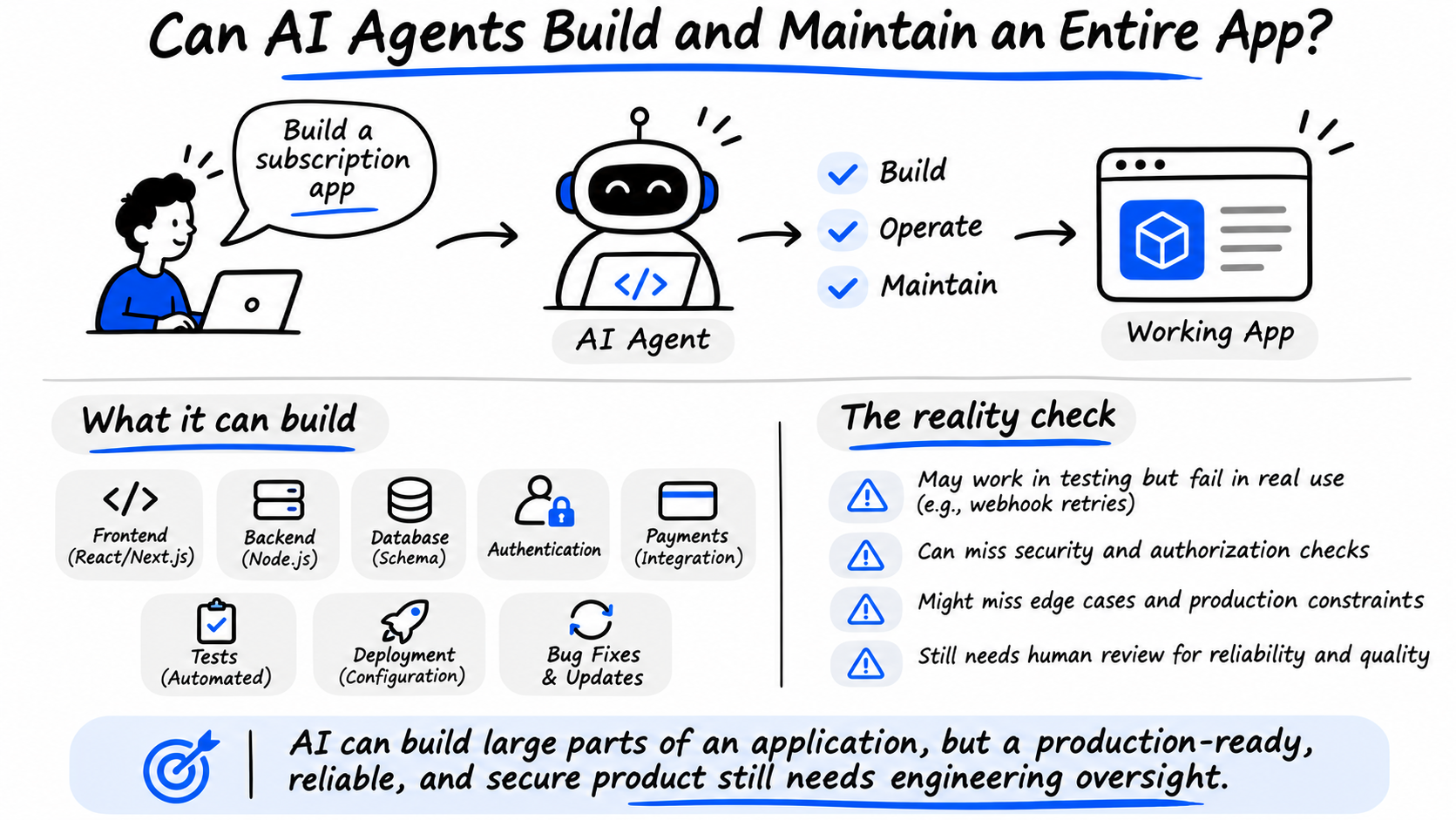
Imagine describing an application to an AI agent and walking away.
A few hours later, it has created the frontend, connected the database, implemented authentication, written APIs, configured deployment, and published a working application.
Now imagine coming back a week later. A user reports a bug. The agent investigates the issue, identifies the faulty function, writes a fix, runs tests, and prepares an updated release.
No developer manually wrote the code. No one spent hours debugging the application.
This sounds like the future of software development, and parts of it are already becoming possible.
AI coding agents can now work across entire repositories, execute commands, modify multiple files, run tests, and interact with development tools. Some can even operate through browsers and deployment environments.
But there is a much bigger question:
Can AI agents actually build, operate, and maintain an entire software application without developers?
The answer is more complicated than a simple yes or no.
1. can AI agents really build an entire application?
Building software involves much more than writing code. An application needs a frontend, backend, database, authentication, business logic, integrations, testing, and deployment.
Traditionally, developers coordinate these pieces and make decisions about how they should work together.
AI agents are increasingly capable of handling many of these responsibilities.
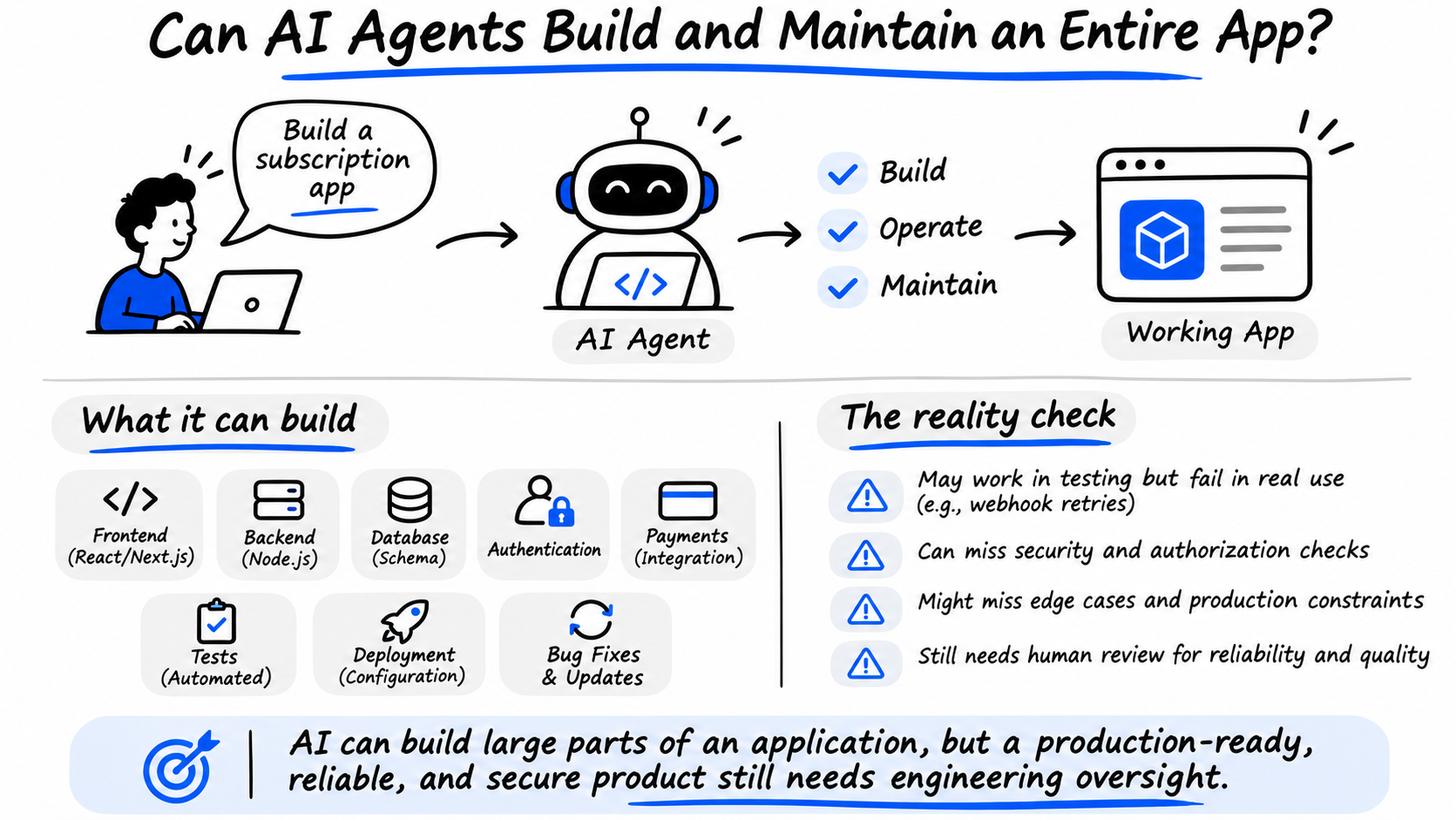
For example, you could ask an agent to build a subscription management platform with user authentication, payment integration, billing history, and an administrative dashboard.
The agent could:
- Create the frontend using React or Next.js.
- Build backend APIs using Node.js.
- Design database schemas.
- Implement authentication.
- Integrate payment providers.
- Generate automated tests.
- Configure deployment.
- Fix errors discovered during development.
Tools such as OpenAI Codex, Claude Code, and GitHub Copilot coding agent demonstrate how AI systems can work directly with repositories and development environments.
However, there is an important distinction between generating a working application and building a production-ready product.
An agent might create a payment integration that works during testing but fails when a webhook arrives twice. It might generate authentication logic without properly enforcing authorization across every endpoint.
The application exists, but its reliability has not yet been established.
AI can build substantial parts of an application. Whether those parts are correct, secure, and maintainable is a separate engineering problem.
2. how much of the software development lifecycle can AI automate?
Software development is a continuous process. Writing the first version of an application is only one part of it.
Let's look at the major stages and what AI agents can do.
| Development stage | What AI agents can do |
|---|---|
| Planning | Convert requirements into tasks and implementation plans |
| Architecture | Suggest system designs and identify dependencies |
| Coding | Generate features, APIs, and database logic |
| Testing | Write tests, execute them, and investigate failures |
| Debugging | Inspect logs, reproduce issues, and propose fixes |
| Code review | Identify potential bugs and risky changes |
| Deployment | Prepare configurations and deployment workflows |
| Monitoring | Analyze logs, errors, and performance signals |
| Maintenance | Update dependencies, fix bugs, and refactor code |
The interesting part is that these capabilities can be connected into a continuous workflow.
For example, an agent receives a task, examines the repository, implements a feature, runs tests, and creates a pull request for review.
If a test fails, it can investigate the failure and attempt another implementation.
This is significantly different from asking a chatbot to generate a function and manually copying the result into a project.
However, not every stage can be safely automated in every application. Architecture decisions, security-sensitive changes, production deployments, and complex incidents may require human approval and expertise.
The goal is to automate execution without removing accountability.
3. the rise of autonomous software engineering agents
One of the biggest developments in AI coding is the transition from code assistants to autonomous coding agents.
Traditional coding assistants generally help developers write code while they work.
Autonomous agents can receive a task, explore a codebase, make changes, run commands, inspect results, and continue working through multiple steps.
Consider OpenAI Codex. It can work on software engineering tasks in isolated environments, inspect repositories, edit code, run tests, and prepare changes for developers to review.
Claude Code takes a similar agent-oriented approach, allowing developers to interact with codebases, use terminal commands, edit files, and coordinate development workflows.
GitHub Copilot coding agent can also work on assigned issues and prepare pull requests for review.
These systems represent an important change in the developer's role.
Instead of manually implementing every function, a developer can describe the desired outcome, assign work to agents, evaluate their output, and make higher-level technical decisions.
There is also an emerging approach called multi-agent software development.
In this architecture, different agents can handle different responsibilities. One might investigate requirements, another implement the backend, another build the frontend, and another review the changes.
But coordinating multiple agents introduces its own problems, including conflicting changes, duplicated work, inconsistent assumptions, and integration failures.
More agents do not automatically mean better software.
4. why maintaining software is harder than building it
Here is where the biggest challenge begins.
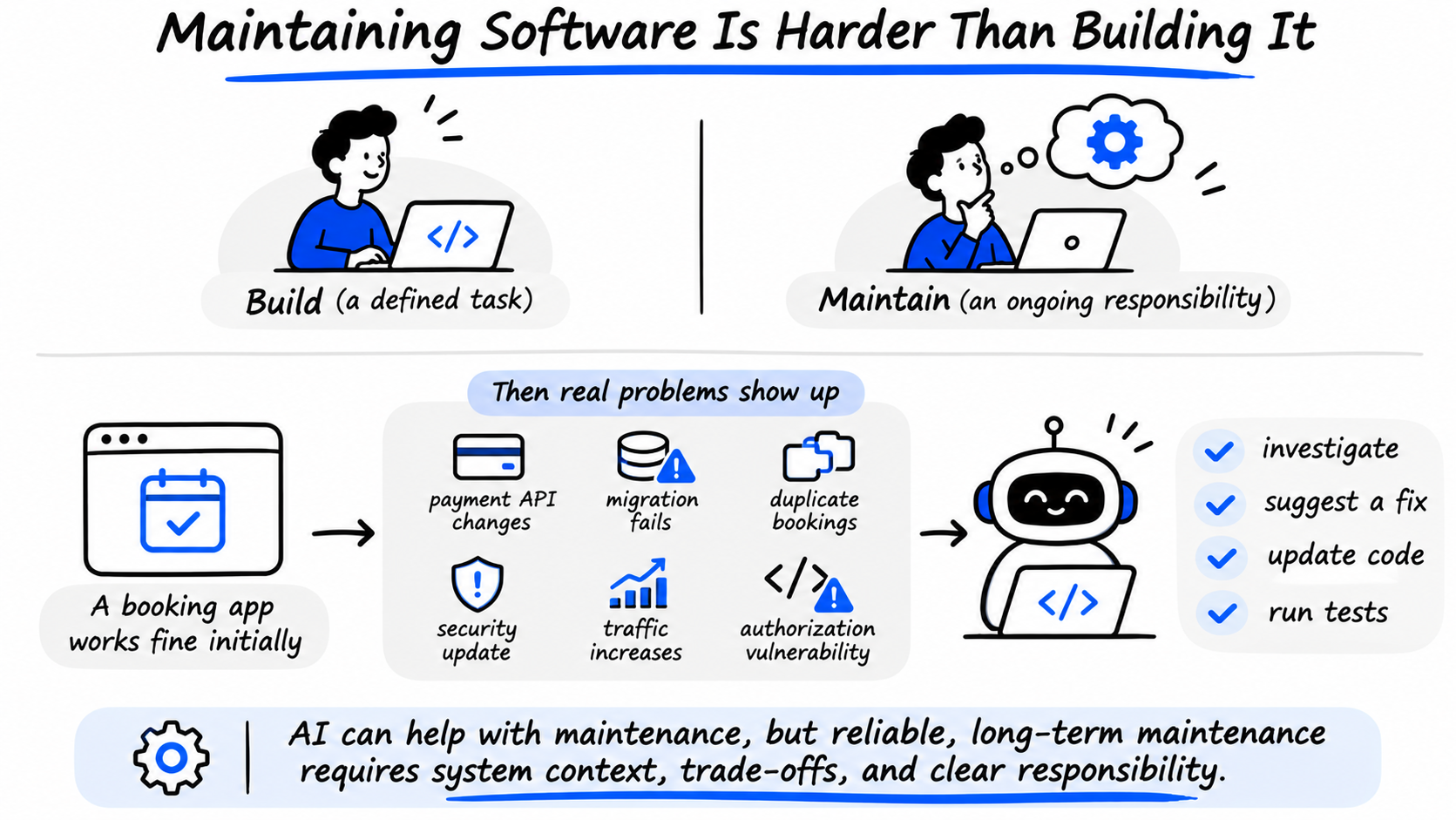
Building an application is a relatively defined task. Maintaining it is an ongoing responsibility.
A production application must handle unexpected inputs, changing requirements, security vulnerabilities, database failures, API changes, infrastructure problems, and unpredictable user behavior.
Imagine an AI agent has built a booking application.
Everything works initially. Users can register, browse available services, make bookings, and receive confirmation emails.
Then several problems appear:
- A payment provider changes its API.
- A database migration fails.
- Users report duplicate bookings.
- A dependency receives a critical security update.
- Traffic increases and the application becomes slow.
- An attacker discovers an authorization vulnerability.
Can an AI agent fix these problems?
In many cases, it can investigate the issue, suggest a solution, modify the code, and run relevant tests.
But the difficult part is understanding the consequences of its changes.
A database migration might fix one issue while breaking older records. A dependency update might introduce an incompatible API. A performance optimization might create a race condition.
This is why software maintenance requires more than the ability to generate code.
It requires understanding the system's history, architecture, users, operational constraints, and acceptable risk.
AI agents can assist with maintenance, but maintaining a production system reliably requires strong feedback mechanisms and clear responsibility.
5. the biggest problem: who is responsible when an AI agent breaks production?
Imagine giving an AI agent permission to deploy changes directly to a production application.
It identifies a bug, modifies the code, runs a few tests, and publishes the update.
But the new release introduces a database issue that affects thousands of users.
Who is responsible?
The AI model? The agent framework? The developer who configured the permissions? The company operating the application?
This is not just a technical question. It is an accountability problem.
AI agents can make incorrect assumptions, misinterpret instructions, or follow malicious content. If they have unrestricted access to production infrastructure, those mistakes can become expensive incidents.
A reliable autonomous development system therefore needs safeguards.
Permission boundaries: Agents should receive only the access required for their assigned tasks.
Automated testing: Changes should pass relevant checks before reaching production.
Human approval: Sensitive operations, destructive database changes, and high-risk deployments should have appropriate approval requirements.
Monitoring: Systems should track errors, performance, unusual behavior, and important agent actions.
Rollback mechanisms: A failed deployment should have a tested recovery path.
The important principle is that an agent should not be able to cause unlimited damage simply because it can execute commands.
Autonomy without boundaries is not reliable engineering.
6. what AI agents still cannot reliably handle
Despite rapid improvements, there are several areas where autonomous software development remains difficult.
Understanding ambiguous requirements
A client might say, "Make the checkout experience faster and easier."
That statement does not define the expected behavior, business rules, payment constraints, or acceptable trade-offs. Someone must determine what success actually means.
Making long-term architectural decisions
An agent can suggest an architecture, but selecting one requires understanding future requirements, operational costs, team capabilities, and the consequences of technical decisions.
Handling unexpected production failures
Agents can analyze logs and propose fixes, but complex incidents often involve multiple interacting systems and incomplete information.
Guaranteeing security
Passing automated security checks does not prove that an application is secure. Vulnerabilities can exist in business logic, authorization rules, integrations, and system design.
Understanding human and business priorities
An agent can optimize a feature according to specified requirements. It cannot automatically determine whether those requirements reflect the right business decision.
These limitations are not necessarily permanent. Models and agent frameworks will continue improving. But better coding ability alone will not solve every problem involved in operating software.
7. what happens to software developers if AI can build applications?
This is probably the question developers care about most.
If AI agents can write code, generate tests, debug errors, and prepare deployments, what exactly will developers do?
The answer may be that the nature of software engineering changes.
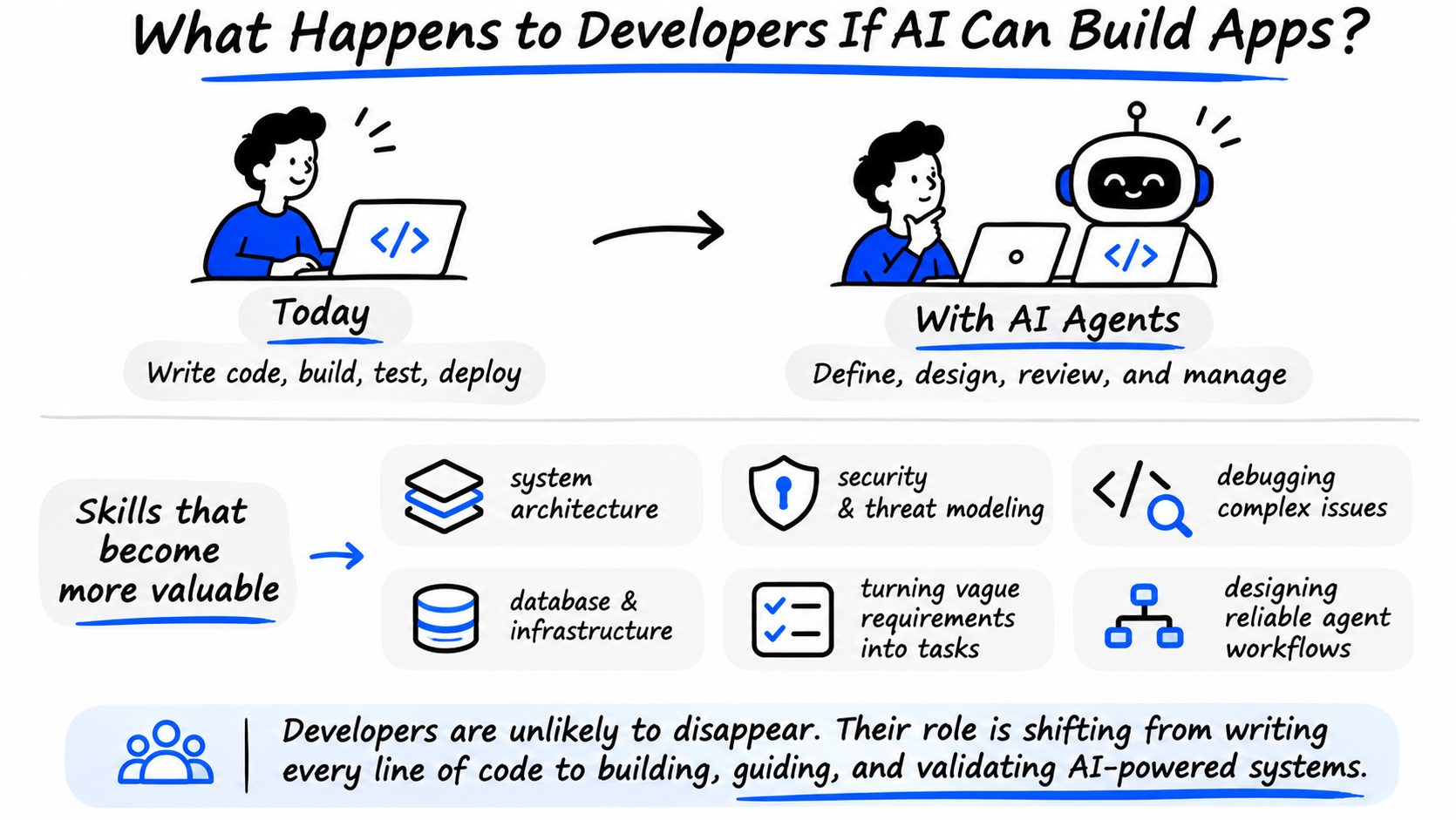
Developers will increasingly spend time defining problems, designing systems, reviewing agent-generated changes, evaluating trade-offs, managing security, and deciding how software should behave.
Some repetitive implementation tasks may become heavily automated. But the need for people who understand systems, users, and technical consequences will remain important.
In fact, certain engineering skills may become more valuable:
- System architecture and design.
- Debugging complex failures.
- Security and threat modeling.
- Code review and verification.
- Database and infrastructure design.
- Breaking ambiguous requirements into precise tasks.
- Designing reliable AI agent workflows.
The developer may move from writing every line of code to managing a system that produces and validates code.
That does not mean every developer will automatically become an AI agent manager. Deep technical knowledge will still matter because someone needs to understand whether the agent's decisions make sense.
The future is likely to involve more collaboration between engineers and autonomous systems, rather than an immediate disappearance of developers.
8. can a solo founder build a startup without hiring developers?
This is where AI agents could have a particularly interesting impact.
A solo founder with a product idea can now use AI tools to build prototypes, create interfaces, implement basic backend functionality, and deploy early versions without assembling a traditional engineering team.
For small applications with clear requirements, limited integrations, and relatively low operational risk, this can be a major advantage.
A founder could validate an idea, launch an MVP, collect user feedback, and iterate much faster than before.
However, the situation changes when the product starts handling sensitive data, processing payments, supporting thousands of users, or becoming critical to customers.
At that point, reliability, security, scalability, and maintenance become much more demanding.
AI can reduce the amount of manual engineering work required, but it does not eliminate the need for engineering judgment.
The most realistic opportunity is not that every founder can replace an entire engineering organization with one AI agent.
It is that a small team can accomplish work that previously required significantly more people.
conclusion: software without developers is not the real question
AI agents are already changing how applications are built. They can write code, inspect repositories, run tests, investigate bugs, and assist with deployment and maintenance.
But building software and taking responsibility for software are two different things.
A production application must survive changing requirements, unexpected failures, security threats, and real users. That requires more than a model capable of generating code.
The future may bring systems that can independently handle much larger portions of the software lifecycle. But the most reliable implementations will still need clear objectives, controlled permissions, strong verification, and accountability.
The developer's role may change dramatically. The responsibility of engineering will not disappear.
"AI may eventually write an entire application without a developer. The harder question is whether it can take responsibility for everything that happens after the first user arrives."
references
- OpenAI, Introducing Codex: https://openai.com/index/introducing-codex/
- OpenAI, Codex Cloud: https://openai.com/codex/
- Anthropic, Claude Code Overview: https://code.claude.com/docs/en/overview
- GitHub, About GitHub Copilot Coding Agent: https://docs.github.com/en/copilot/concepts/agents/coding-agent/about-coding-agent
- Anthropic, Effective Harnesses for Long-Running Agents: https://www.anthropic.com/research/effective-harnesses-for-long-running-agents
- Google Cloud, What Is Agentic AI?: https://cloud.google.com/discover/what-is-agentic-ai
- OWASP, AI Agent Security Cheat Sheet: https://cheatsheetseries.owasp.org/cheatsheets/AI_Agent_Security_Cheat_Sheet.html