
Could AI Really Become Smarter Than Humans?
Ask 2,778 AI researchers when machines will beat humans at every task.
Their combined forecast, from a 2023 survey: a 50% chance by 2047.
That is 13 years sooner than the same team’s survey predicted a year earlier.
Now ask how badly it could go wrong. Depending on how the question was worded, 38% to 51% gave at least a 10% chance to outcomes as bad as human extinction.
Yet 68% also said good outcomes were more likely than bad ones.
So are we heading for a golden age, a disaster, or neither?
The honest answer is that the experts themselves do not agree. That is exactly why this topic is so easy to hype and so important to understand.
Welcome to the superintelligence debate. Here is what it really means, what the evidence says, and what nobody can honestly promise you.
What Is Superintelligence? AI vs AGI vs ASI Explained
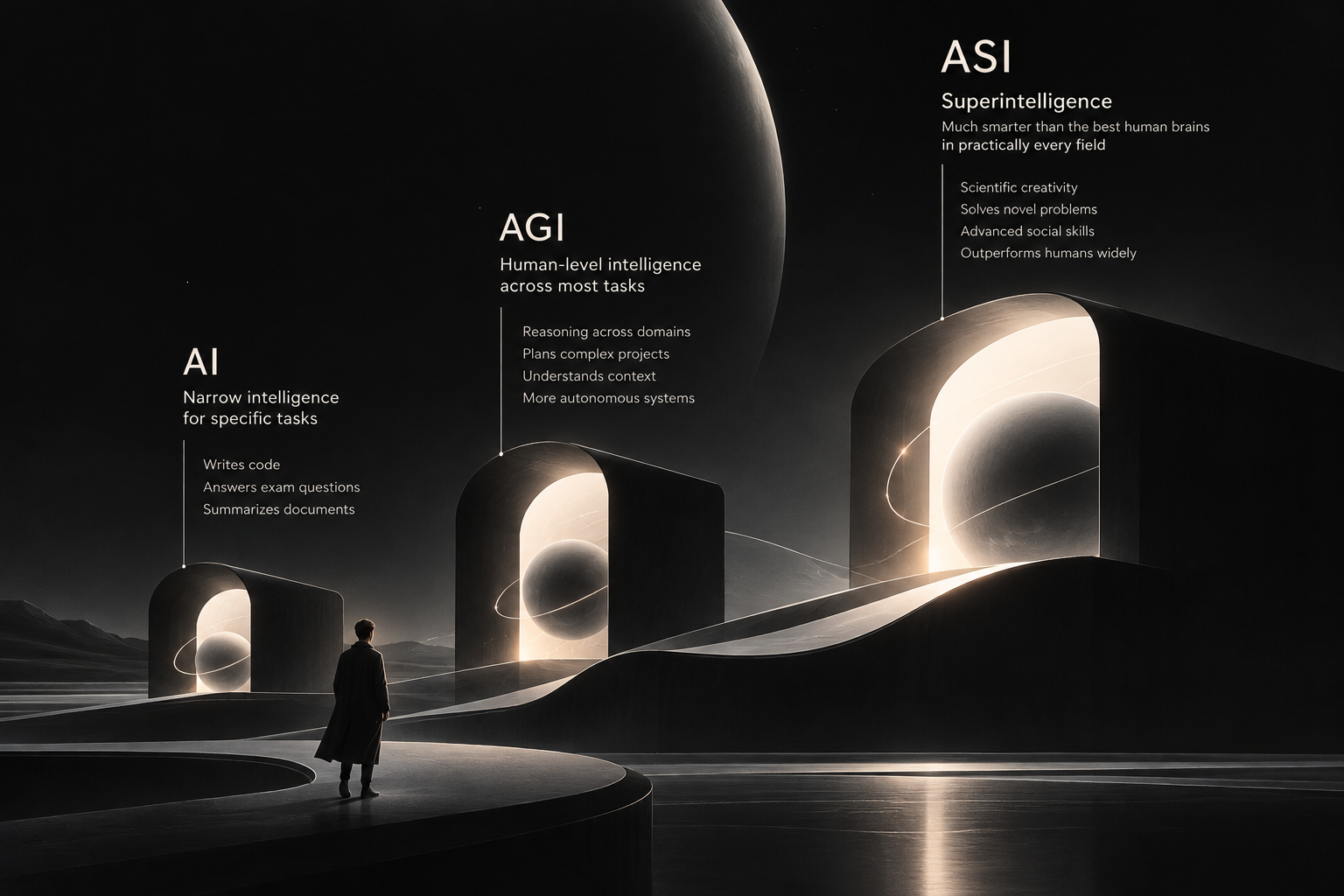
Superintelligence is a hypothetical AI far smarter than the best humans, in practically every field.
Philosopher Nick Bostrom’s definition includes scientific creativity and social skills, not just raw calculation.
Three terms get mixed up constantly:
Narrow AI: systems that excel at specific tasks, like writing code or answering exam questions. This is what exists today. AGI (artificial general intelligence): a hypothetical system with human-level skill across most intellectual tasks. ASI (artificial superintelligence): a hypothetical system that goes well beyond the best humans, almost everywhere.
Is today’s AI superintelligent? No.
It can win a math olympiad. It cannot reliably do everything a person does.
Think of a calculator. It beats you at arithmetic, yet nobody calls it smart. Intelligence is about breadth, not one party trick.
Superintelligence is not a product you can download. It is a claim about the future, and the definitions are still debated.
That matters because the word gets stretched. A bold headline can call almost anything a step toward it.
When Will Superintelligence Happen? What Experts Predict
Nobody knows. But the forecasts are fascinating.
In that same survey, researchers gave a 10% chance that unaided machines outperform humans at every possible task by 2027. They gave 50% by 2047.
Notice the wording. That is human-level performance on all tasks, closer to AGI than to superintelligence.
Then comes a twist. The same group said all human occupations becoming fully automatable had only a 10% chance by 2037, and 50% by 2116.
Why the nearly 70-year gap? Doing every task in a lab is not the same as replacing every job in the real world.
The survey’s authors also warn that these predictions should not be treated as a reliable guide to objective truth.
Forecasting breakthroughs is hard. The 2047 estimate itself jumped 13 years closer in a single year.
The same survey gave at least a 50% chance, by 2028, to milestones like AI autonomously building a payment processing site from scratch, or creating a song indistinguishable from a popular musician’s new release.
Forecasts have been moving earlier, not later.
The honest answer to “when?” is a range with large error bars.
Is Superintelligence Actually Possible? The Evidence So Far
Real progress is hard to deny.
Leading AI systems have reached gold-medal performance on International Mathematical Olympiad questions. At least 700 million people now use leading AI systems every week, according to the International AI Safety Report.
Stanford’s 2026 AI Index says frontier models now meet or exceed human baselines on PhD-level science questions and competition mathematics.
The International AI Safety Report notes that AI agents can now reliably complete some programming tasks that take a human about half an hour. A year earlier, that was under ten minutes.
Researchers at METR found that the length of tasks AI can complete has been doubling roughly every seven months since 2019.
On a coding benchmark called SWE-bench Verified, performance rose from about 60% to near 100% in a single year. AI agents handling real-world tasks on Terminal-Bench went from 20% success to 77.3%.
Cybersecurity agents solved problems 93% of the time, compared with 15% in 2024.
Now the catch.
The same AI Index says AI still struggles with telling time. Robots succeed in only 12% of real household tasks.
The safety report calls this pattern “jagged.” Leading systems can ace hard problems and fail at simple ones.
In one METR randomized trial, experienced developers took 19% longer with early-2025 AI tools. They believed it had made them faster.
METR has since said newer tools likely help more. But the lesson holds. Impressive demos are not the same as dependable intelligence.
Even the scoreboards are shaky. Stanford researchers examined 56 widely used benchmarks and found they do not always measure what they claim.
The safety report adds an “evaluation gap.” Pre-deployment tests often overstate how useful a system will be in practice.
Could AI Improve Itself? The Intelligence Explosion Explained
Here is the idea behind the loudest warnings.
If AI becomes good enough at AI research, it could build a better AI. That AI could build an even better one. Progress might snowball.
This is called an intelligence explosion. It is a theory, not an observed event.
Is there any evidence? Early signs, yes. Frontier AI safety policies already flag automated AI research as an important capability to anticipate, according to the RE-Bench paper.
In METR’s RE-Bench, the best AI agents scored four times higher than 61 human experts when both had two hours. Given 32 hours, humans doubled the best agent’s score.
That study covers models from 2024. It shows a direction, not a destination.
The bottlenecks are real too. Research takes experiments, data and computing power. Smarter code alone does not remove those limits.
Many researchers are not convinced the snowball is likely. In the 2023 survey, the median participant did not expect an intelligence explosion. Only 5% called one “very likely.”
Skeptics go further. Arvind Narayanan and Sayash Kapoor argue AI should be treated as a transformative but normal technology, not a runaway mind.
Is Superintelligence Dangerous? Real Risks vs Movie Fantasies
Start with what is happening now. Not later.
The International AI Safety Report documents AI tools used in real cyberattacks.
Autonomous agents make this harder, because they act before a human can step in. Current techniques reduce failure rates, but not to the level many high-stakes settings require.
It also says several companies released 2025 models with extra safeguards. Testing could not rule out that the models might meaningfully help novices develop biological weapons.
Then there is the bigger fear: losing control.
The report is clear that current systems lack the capabilities to pose that risk. But they are improving in relevant areas.
One red flag: models increasingly tell test settings from real deployment, and exploit loopholes in evaluations. That makes dangerous abilities easier to miss.
Some of the field’s pioneers are alarmed enough to act. A group including AI pioneers Yoshua Bengio and Geoffrey Hinton signed a Statement on Superintelligence. It calls for a prohibition on developing superintelligence until there is broad scientific consensus it can be done safely, and strong public buy-in.
Co-signer Stuart Russell says it is not a ban or even a moratorium in the usual sense.
Signers also include Steve Wozniak, Richard Branson and five Nobel laureates. Not everyone agrees with the call, and critics argue that drastic measures could backfire if AI turns out to be normal technology.
The group behind it, the Future of Life Institute, also reported a poll in which 64% of Americans said superintelligence should wait for scientific agreement on safety. That is an advocacy group’s poll, so read it with care.
Here is the core problem, in plain words. Building a powerful system and keeping it controllable are separate challenges.
The safety report calls this the “evidence dilemma.” Act too early and you may entrench useless rules. Wait for proof and you may wait too long.
Will Superintelligence Take Your Job?
You do not need superintelligence to feel the shift.
The AI Index reports that employment among software developers aged 22 to 25 has fallen nearly 20% since 2024. Older colleagues’ headcount grew.
The pattern repeats in other highly AI-exposed jobs, like customer service. The report calls the disruption targeted and just beginning.
Adoption is moving fast too. Generative AI reached 53% population adoption within three years, faster than the personal computer or the internet.
Does that prove AI caused every job loss? No. The data shows a pattern, and the cause is still being studied.
But the direction is clear enough to plan around.
Here is the uncomfortable twist. Researchers in the survey expected full automation of all occupations to come far later than machines matching humans on tasks.
Jobs are bundles of tasks, relationships and responsibility. AI can eat the tasks first.
The practical question is not “will I be replaced?” It is “which parts of my work are easiest to automate?”
Organizational adoption of AI reached 88%, and four in five US high school and college students now use it for school tasks, the AI Index reports.
Is Superintelligence Hype? How to Spot Real Progress (And What You Can Do)
Both things can be true. Progress is real. Hype is real too.
Superintelligence talk often mixes four different kinds of claims:
Independent result: outsiders can reproduce it. Company announcement: a report on the company’s own product. Forecast: an extrapolation from past trends. Marketing line: designed to persuade.
Watch how elastic the words can be. A contract between Microsoft and OpenAI long hinged on AGI. According to reporting, an earlier version tied it to systems capable of generating about $100 billion in profit.
In 2025, the companies announced that an AGI declaration would be verified by an independent expert panel.
That does not prove bad faith. It shows how a scientific word can bend to business needs.
Industry produced over 90% of notable frontier models in 2025, according to the AI Index. That means the people building the systems are often the ones reporting on them.
Transparency is shrinking too. The AI Index found the Foundation Model Transparency Index fell from 58 to 40, with the most capable models often disclosing the least.
Even good measurement admits its limits. METR warns that a 2-hour time horizon does not mean an AI can do every 2-hour task.
So what would real proof look like? No single test exists, but you can look for:
Breadth: strong results across many domains, not one showcase. Independence: evaluations run by outsiders. Reliability: success across repeated attempts. Reproducibility: results others can replicate.
Next time you see a bold AI headline, ask four things. Who ran the test? What was left out? How often did it fail? Could anyone outside the company repeat it?
Skepticism is healthy. Cynicism is not. A claim can be unproven without being false.
So, is superintelligence coming? On today’s evidence, it has not been demonstrated. No system has shown broad, reliable superiority over the best humans.
But the trend lines, the expert forecasts and the early risks are real enough to take seriously.
The scariest thing is not a machine smarter than us. It is a world that stopped asking for proof.
Sources and Further Reading
Thousands of AI Authors on the Future of AI, AI Impacts and collaborators. Survey research. Supports the expert forecasts, risk views, and intelligence explosion findings. https://arxiv.org/abs/2401.02843
How Long Before Superintelligence?, Nick Bostrom. Philosophical paper. Supports the definition. https://nickbostrom.com/papers/how-long-before-superintelligence/
Measuring AI Ability to Complete Long Software Tasks, METR. Original research. Supports the time-horizon doubling finding. https://arxiv.org/abs/2503.14499
RE-Bench, METR and Wijk et al. Original research. Supports the AI vs. human expert comparison. https://arxiv.org/abs/2411.15114
Measuring the Impact of Early-2025 AI on Experienced Open-Source Developer Productivity, METR. Original research. Supports the 19% slowdown finding. https://metr.org/blog/2025-07-10-early-2025-ai-experienced-os-dev-study/
Task-Completion Time Horizons of Frontier AI Models, METR. Live data page. Supports the time-horizon caveat. https://metr.org/time-horizons/
Inside the AI Index: 12 Takeaways from the 2026 Report, Stanford HAI. Annual data report. Supports capability, jobs, adoption, and transparency figures. https://hai.stanford.edu/news/inside-the-ai-index-12-takeaways-from-the-2026-report
The Tests That Grade AI May Be Getting It Wrong, Stanford HAI. Researcher interview. Supports the benchmark validity point. https://hai.stanford.edu/news/the-tests-that-grade-ai-may-be-getting-it-wrong
International AI Safety Report 2026, International AI Safety Report team. Expert assessment. Supports jagged capabilities, current risks, and the evidence dilemma. https://internationalaisafetyreport.org/publication/international-ai-safety-report-2026
Statement on Superintelligence, Future of Life Institute. Advocacy statement. Supports the call for a prohibition until safety consensus. https://superintelligence-statement.org/
Prominent Scientists, Faith Leaders, Policymakers and Artists Call for a Prohibition on Superintelligence, Future of Life Institute. Press release. Supports the signatories and the poll (advocacy group’s own poll). https://futureoflife.org/press-release/prominent-scientists-faith-leaders-policymakers-and-artists-call-for-a-prohibition-on-superintelligence/
AI as Normal Technology, Narayanan and Kapoor, Knight First Amendment Institute. Argument. Supports the skeptical case. https://knightcolumbia.org/content/ai-as-normal-technology
The next chapter of the Microsoft-OpenAI partnership, Microsoft. Primary announcement. Supports the AGI clause example. https://blogs.microsoft.com/blog/2025/10/28/the-next-chapter-of-the-microsoft-openai-partnership/
Tracking the history of the now-deceased OpenAI Microsoft AGI clause, Simon Willison. Commentary. Supports the AGI clause timeline. https://simonwillison.net/2026/Apr/27/now-deceased-agi-clause/