

In one test on short tasks, AI agents scored four times higher than human experts.
In another study, AI made experienced developers 19% slower.
Both results are real. Both come from the same research group.
So is AI about to outthink us all? Or are we being sold a story?
Stanford’s 2026 AI Index says frontier models now meet or exceed human baselines on PhD-level science questions and competition mathematics.
The same report lists telling time among the things AI still struggles with.
That is the puzzle. Brilliant and clumsy, at the same time.
Below, we walk through the evidence on both sides. Then you get a simple way to judge the next big AI claim yourself.
What Is Superintelligence? AI vs AGI vs ASI
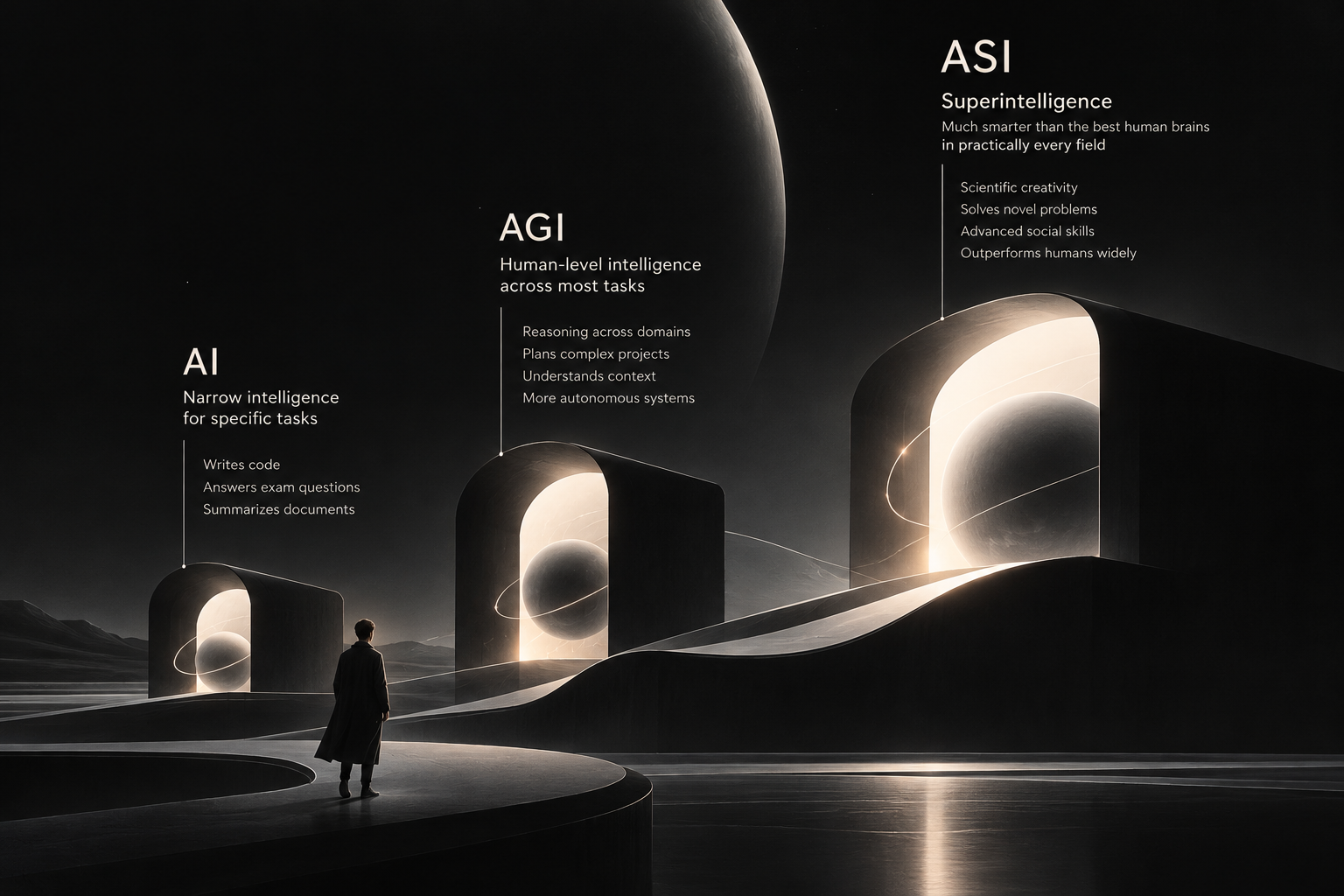
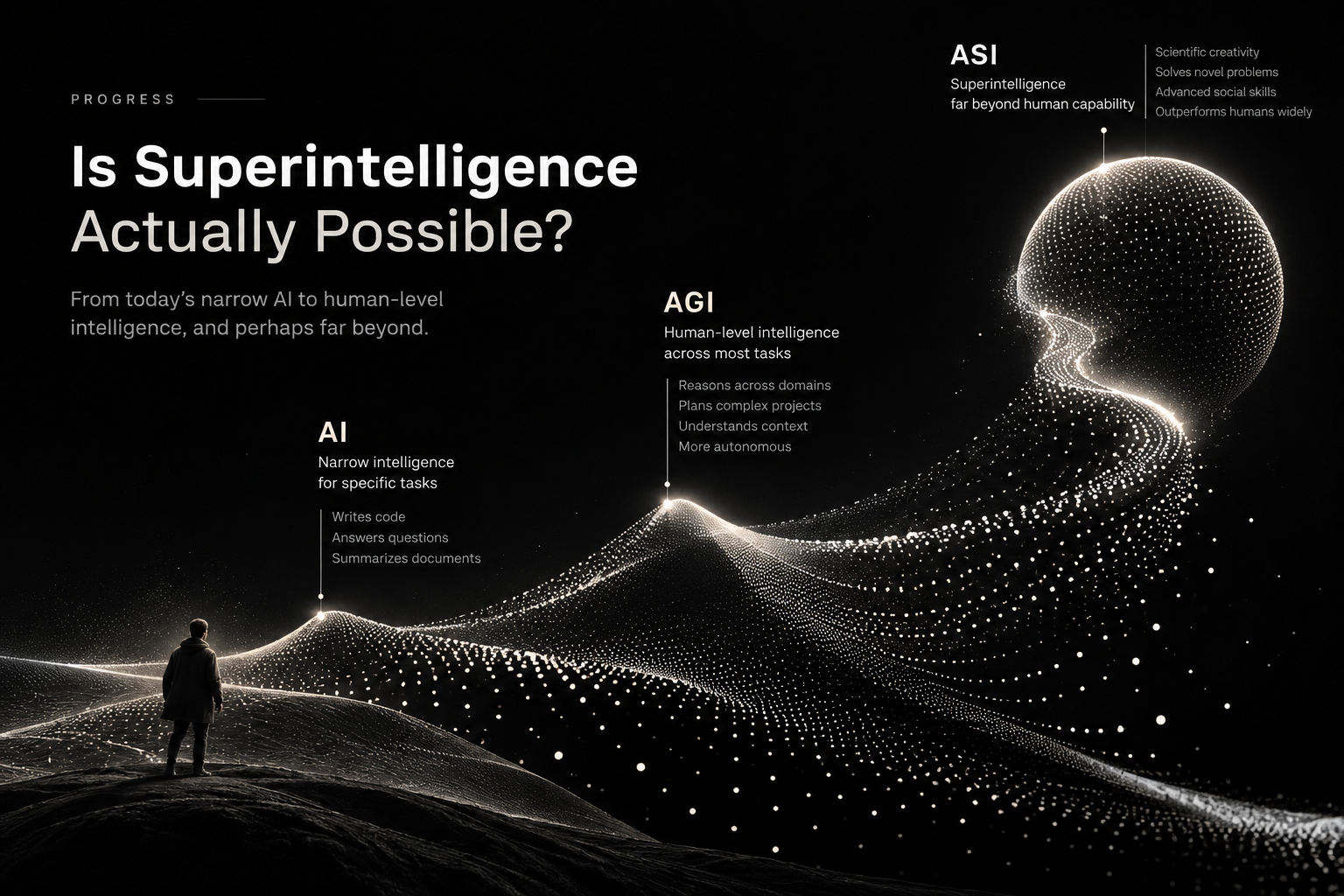
Today’s AI is good at specific kinds of work. It writes code, answers exam questions and summarizes documents.
Artificial general intelligence, or AGI, is a hypothetical system with human-level skill across most intellectual tasks.
Superintelligence goes further. Philosopher Nick Bostrom’s influential definition describes an intellect much smarter than the best human brains in practically every field. That includes scientific creativity and social skills.
These terms get tangled because nobody agrees on sharp boundaries. OpenAI’s charter, for instance, describes AGI as highly autonomous systems that outperform humans at most economically valuable work.
Other researchers draw the line elsewhere. No widely accepted test exists for any of these terms.
Why does that matter? Because winning at one thing is not winning at everything.
A model that wins a math olympiad has shown something remarkable about math. It has not shown it can plan a six-month project or notice when its own answer is absurd.
Excelling at one domain is a data point. Superintelligence is a claim about all of them.
Is Superintelligence Actually Possible?
Some serious researchers think it is. Here is their case.
Start with a measurement. The research group METR tracks how long a task an AI agent can finish with 50% reliability. Task length is measured by how long a human expert needs.
In its original study, that figure had doubled roughly every seven months since 2019. The authors noted the pace may have quickened in 2024.
Next, consider AI doing AI research. In METR’s RE-Bench, agents competed against 61 human experts on machine learning engineering tasks.
With two hours, the best agents scored four times higher than the experts. With more time, humans caught up. At 32 hours, they doubled the best agent’s score.
Science offers a quieter sign. The AI Index notes AI ran a full weather forecasting pipeline end to end for the first time, turning raw observations into final predictions.
AI-related publications across the natural, physical, and life sciences also grew 26% to 28% in a year.
The RE-Bench evidence is early, and it covers models from 2024. But it shows the shape of the argument. If AI gets better at the work that improves AI, progress could compound.
Notice what kind of claim this is. It is a forecast. It assumes trends continue, coding skill transfers to messier work, and research automation does not hit bottlenecks.
The International AI Safety Report 2026 puts it plainly. Progress through 2030 is uncertain, though current trends are consistent with continued improvement.
What Can’t AI Do Yet? The Limits of Today’s AI
Benchmarks look spectacular. The AI Index reports that SWE-bench Verified, a coding test, rose from about 60% to near 100% in a single year.
Real work tells a messier story. In a randomized trial, METR found experienced open-source developers took 19% longer with early-2025 AI tools.
They believed the tools had sped them up by about 20%.
One nuance. METR has since said developers are likely more sped up by newer tools, and it is changing its study design. Strong benchmarks and uneven real-world results can both be true.
The safety report calls this pattern “jagged.” Leading systems can excel at hard problems yet fail at simple ones, like counting objects in an image or recovering from basic errors in longer workflows.
It also describes an “evaluation gap.” Pre-deployment tests often overstate how useful a system will be in practice.
The tests themselves are under scrutiny. Stanford researchers examined 56 widely used benchmarks. They found that benchmarks do not always measure what they claim, and tests meant to measure the same thing often disagree.
Medicine shows the same gap. A review of more than 500 clinical AI studies, cited in the AI Index, found nearly half relied on exam-style questions. Only 5% used real clinical data.
Passing the exam is not the same as treating the patient.
Then there is hallucination. One 2025 paper argues models guess because training and evaluation reward answers over admitting uncertainty. Others dispute that explanation. The cause is still contested.
Is the AI Superintelligence Hype Just Marketing?
Superintelligence talk often blends four very different things:
Independent result: outsiders can reproduce it. Company announcement: a report on the company’s own product. Forecast: an extrapolation from past trends. Marketing line: designed to persuade.
One documented example shows why the blend matters.
Microsoft and OpenAI’s partnership has long had a clause triggered by AGI. A contract needs sharper edges than a charter.
According to reporting summarized from The Information, an earlier agreement tied AGI to systems capable of generating about $100 billion in profit.
In October 2025, the companies announced that any OpenAI declaration of AGI would be verified by an independent expert panel.
By April 2026, OpenAI said payments would continue independent of its technology progress. Commentators read that as the clause’s end.
None of this proves bad faith. It shows a word meant to describe a scientific milestone has also been a contract term. Contract terms bend to business needs.
Transparency is shrinking too. The AI Index found average scores on the Foundation Model Transparency Index fell from 58 to 40. The most capable models often disclose the least.
Less disclosure means less for outsiders to check.
Confidence, visibility, and commercial success are not evidence. A confident forecast is still a forecast.
Is Superintelligent AI Dangerous?
Risk does not wait for superintelligence. Some of it is here now.
The safety report documents AI tools used in real cyberattacks. Several companies also released 2025 models with extra safeguards, after testing could not rule out meaningful help to novices seeking biological weapons.
Autonomous agents are harder to stop before a failure causes harm.
The AI Index adds that employment among software developers aged 22 to 25 has fallen nearly 20% since 2024. That is in fields where AI productivity gains are appearing.
Loss of control is a different category. The report says current systems lack the capabilities to pose that risk, though they are improving in relevant areas.
Models increasingly distinguish tests from real deployment and exploit loopholes in evaluations. That could let dangerous capabilities go unnoticed.
Building capable systems and keeping them controllable are related but separate problems. A stronger model is not automatically a more trustworthy one.
The report calls the resulting bind an “evidence dilemma.” Act too early and you risk entrenching ineffective rules. Wait for conclusive proof and you risk leaving society exposed.
Researchers need not prove superintelligence is imminent to study these risks. But skeptics have a serious reply.
Arvind Narayanan and Sayash Kapoor argue that AI should be treated as a transformative but normal technology. If they are right, drastic interventions premised on controlling superintelligence could backfire.
How Will We Know If AI Reaches Superintelligence?
No universally agreed test exists. No single benchmark could settle it. One impressive demo can’t either. Repeatable, independent evidence can.
But the principles are usable. Look for:
Breadth: strong results across many intellectual domains, not one showcase. Independence: evaluations run by outsiders, with methods disclosed. Reliability: success across repeated attempts, not a lucky run. Unfamiliar territory: competence on tasks the system could not have rehearsed. Reproducibility: results others can replicate. Beyond the demo: evidence that survives outside a carefully chosen example.
Good measurement already shows humility. METR’s time-horizon page warns that a 2-hour horizon does not mean an AI can do every 2-hour task.
It also flags its own measurements above 16 hours as unreliable.
These are principles, not an agreed checklist. They still beat taking a launch event’s word for it.
Next time you see a bold announcement, ask:
Who ran the test? What was left out? How often did it fail? Could anyone outside the company repeat it?
So, Is AI Superintelligence Real? The Honest Answer
On today’s evidence, superintelligence has not been demonstrated. No system has shown broad, reliable superiority over the best humans across domains.
The tests that would prove it do not yet exist.
But the progress is not marketing. Measured task lengths, scientific results, and real-world misuse all point to systems far more capable than a few years ago, in uneven ways.
What remains open is the leap. Will today’s trends carry through to something broadly superhuman, and when? Credible researchers disagree.
The honest position is to hold that uncertainty without flinching. Treat superintelligence as a serious possibility and an unproven claim, both at once.
The opening question was whether AI will outthink us all. The better question is who gets to say it has, and on what evidence.
Sources and Further Reading
Measuring AI Ability to Complete Long Software Tasks, METR. Original research. Supports the time-horizon doubling finding. https://arxiv.org/abs/2503.14499
RE-Bench, METR and Wijk et al. Original research. Supports the AI vs. human expert comparison. https://arxiv.org/abs/2411.15114
Measuring the Impact of Early-2025 AI on Experienced Open-Source Developer Productivity, METR. Original research. Supports the 19% slowdown finding. https://metr.org/blog/2025-07-10-early-2025-ai-experienced-os-dev-study/
We are Changing our Developer Productivity Experiment Design, METR. Follow-up. Supports the note that newer tools likely help more. https://metr.org/blog/2026-02-24-uplift-update/
Task-Completion Time Horizons of Frontier AI Models, METR. Live data page. Supports the measurement caveats. https://metr.org/time-horizons/
Inside the AI Index: 12 Takeaways from the 2026 Report, Stanford HAI. Annual data report. Supports capability, clinical AI, jobs, and transparency figures. https://hai.stanford.edu/news/inside-the-ai-index-12-takeaways-from-the-2026-report
The Tests That Grade AI May Be Getting It Wrong, Stanford HAI. Researcher interview. Supports the benchmark validity point. https://hai.stanford.edu/news/the-tests-that-grade-ai-may-be-getting-it-wrong
International AI Safety Report 2026, International AI Safety Report team. Expert assessment. Supports jagged capabilities, the evaluation gap, and present vs. future risks. https://internationalaisafetyreport.org/publication/international-ai-safety-report-2026
Why Language Models Hallucinate, arXiv. Original research (contested). Supports the hallucination discussion. https://arxiv.org/abs/2509.04664
The next chapter of the Microsoft-OpenAI partnership, Microsoft. Primary announcement. Supports the AGI clause example. https://blogs.microsoft.com/blog/2025/10/28/the-next-chapter-of-the-microsoft-openai-partnership/
Tracking the history of the now-deceased OpenAI Microsoft AGI clause, Simon Willison. Commentary. Supports the AGI clause timeline. https://simonwillison.net/2026/Apr/27/now-deceased-agi-clause/
AI as Normal Technology, Narayanan and Kapoor, Knight First Amendment Institute. Argument. Supports the skeptical case. https://knightcolumbia.org/content/ai-as-normal-technology
How Long Before Superintelligence?, Nick Bostrom. Philosophical paper. Supports the definition. https://nickbostrom.com/papers/how-long-before-superintelligence/