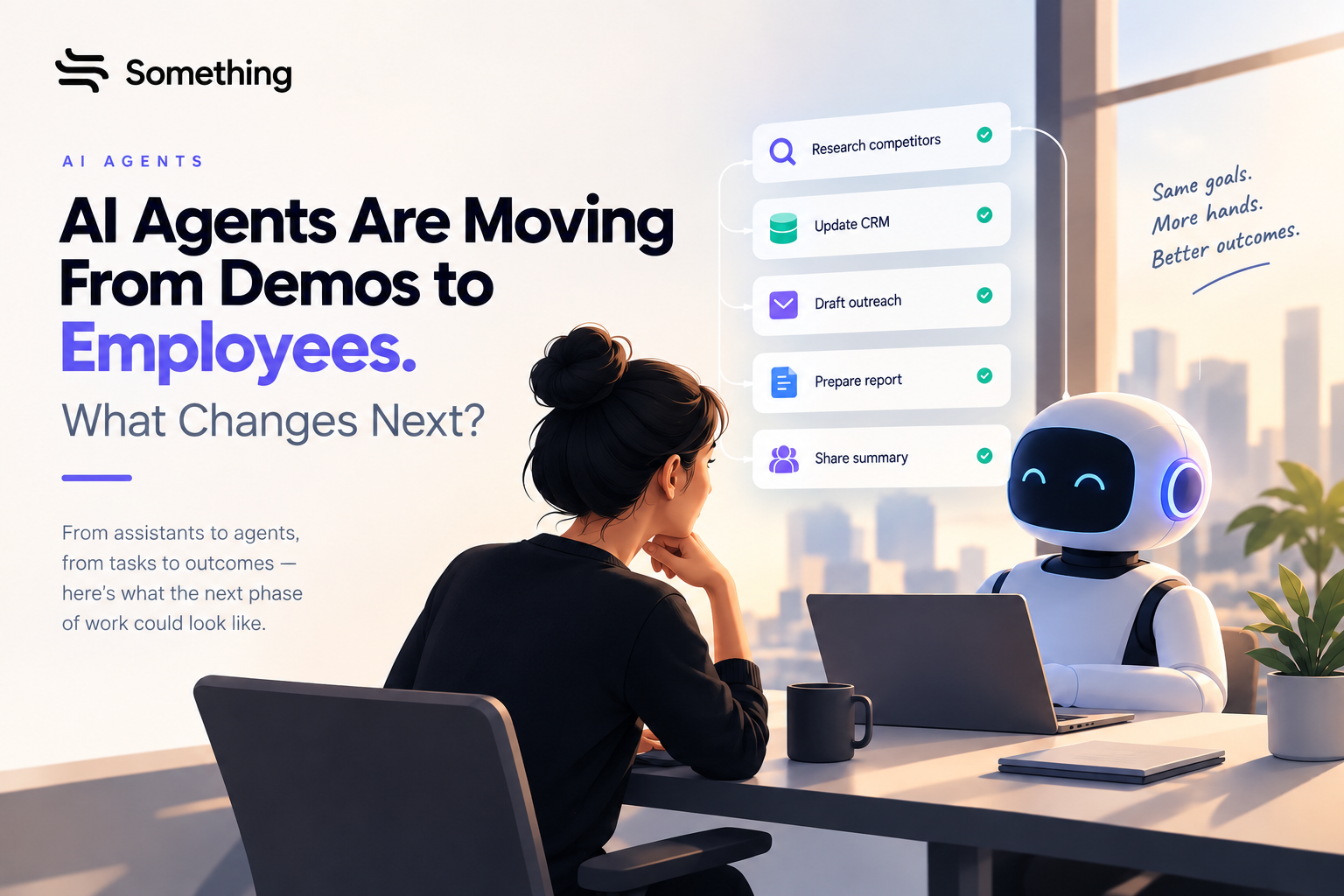
AI Agents Are Moving From Demos to Employees. What Changes Next?
For the last few years, we’ve been building AI assistants.
Ask a question.
Get an answer.
Give it a document.
Get a summary.
Give it some code.
Get a suggestion.
That was the first phase of generative AI: AI that helps humans work.
Something different is happening now.
We are increasingly giving AI responsibility.
“Monitor this.”
“Research this every week.”
“Keep our CRM updated.”
“Handle these support tickets.”
“Build this feature.”
“Keep working on this until it’s done.”
That is the transition from an AI assistant to an AI agent.
And the next transition may be even bigger:
AI agents becoming something much closer to employees.
Not employees in the legal or human sense, of course. But software that can be given an objective, access to tools, a set of permissions, and enough autonomy to work toward an outcome without someone watching every step.
The technology is moving quickly. The harder question is:
What happens to the way companies work when software can own work, not just assist with it?
The shift from asking to delegating
The easiest way to understand the change is to look at how we interact with software.
The traditional model looks like this:
Human → Software → Action
You open Salesforce and update a lead.
You open Jira and create a ticket.
You open Google Sheets and build a report.
Generative AI introduced:
Human → AI → Answer
You ask ChatGPT to analyze the sales pipeline.
You ask it to summarize the tickets.
You ask it to write the report.
Agents introduce another model:
Human → Goal → Agent → Plan → Execute → Verify
Instead of asking:
“How should I analyze our sales pipeline?”
you can increasingly say:
“Analyze our pipeline every Monday, identify unusual changes, investigate the reasons, and send me a summary.”
The difference sounds subtle.
It isn't.
The first model gives you information.
The second gives you work.
OpenAI's recent enterprise data shows this shift happening in practice. As of June 2026, agentic AI usage represented 64% of combined Codex and ChatGPT enterprise output tokens. Agentic usage has also spread rapidly beyond software engineering, with weekly active enterprise Codex users growing 108× in legal, 41× in sales, 41× in recruiting and 26× in marketing since February.
The interesting question is no longer whether agents can perform useful tasks.
It is:
Which tasks should we actually give them?
From tasks to responsibilities
There is a useful distinction between an AI that completes a task and an AI that owns a responsibility.
Consider sales.
A task-oriented AI might:
Find 20 companies that match this ICP.
A more capable agent might:
Find companies, research the decision makers, enrich the CRM, draft personalized outreach and prepare the list for review.
But an AI employee-like system could eventually be given:
Own our outbound prospecting pipeline.
That changes the unit of work.
Instead of assigning the agent individual instructions, you give it an outcome.
The same pattern applies across a company.
Marketing
From:
Write a LinkedIn post.
To:
Own our weekly content pipeline.
Customer support
From:
Answer this ticket.
To:
Resolve Tier-1 customer issues and escalate anything that requires human judgment.
Engineering
From:
Fix this bug.
To:
Monitor this service, investigate recurring failures and open or implement fixes when appropriate.
Research
From:
Summarize these competitors.
To:
Maintain our competitive intelligence and alert us when something materially changes.
This is where the “AI employee” metaphor becomes useful.
The important capability isn't just intelligence.
It's responsibility.
Companies are adopting agents faster than they are redesigning work
There is an important gap emerging.
Companies are rapidly experimenting with agents, but many are still putting them inside workflows designed for humans.
Microsoft's 2026 Work Trend Index found that the number of active agents in the Microsoft 365 ecosystem has grown 15× year over year, reaching 18× year-over-year growth in large enterprises.
At the same time, Microsoft's research suggests that the organizational systems around AI have not caught up with the technology. The company describes the central challenge as a gap between what employees can now do with AI and what their organizations are designed to support.
That's an important distinction.
Adding an agent to an existing workflow is relatively easy.
Redesigning the workflow around the agent is much harder.
Imagine a support organization.
The old workflow might be:
Customer → Ticket → Support agent → Escalation → Resolution
Adding AI gives us:
Customer → Ticket → AI suggestion → Human → Resolution
But a truly agent-native workflow might become:
Customer → Agent → Resolution
↓
Human when necessary
The human isn't necessarily removed.
The human's role changes.
They become responsible for exceptions, judgment and outcomes rather than processing every ticket.
That is a much bigger organizational change than simply adding a chatbot to the support page.
The new organizational chart
For decades, we've roughly organized companies around a simple constraint:
Human attention is scarce.
One manager can manage a certain number of people.
One engineer can maintain a certain number of services.
One salesperson can manage a certain number of accounts.
Agents change the economics of that equation.
Imagine a team with:
- 5 humans
- 20 research agents
- 10 coding agents
- 5 sales agents
- 3 marketing agents
- 2 finance agents
The interesting question is no longer:
“How many employees do we need?”
It becomes:
“How many agents can each person effectively direct?”
Microsoft's research points toward this change: as agents take on more execution, humans can spend more time directing work, making decisions and owning outcomes. Among the AI users surveyed globally, 66% said AI allowed them to spend more time on high-value work, while 58% said AI enabled them to produce work they couldn't have produced a year earlier.
This creates a completely different management problem.
Managers may eventually manage not only people, but systems of agents.
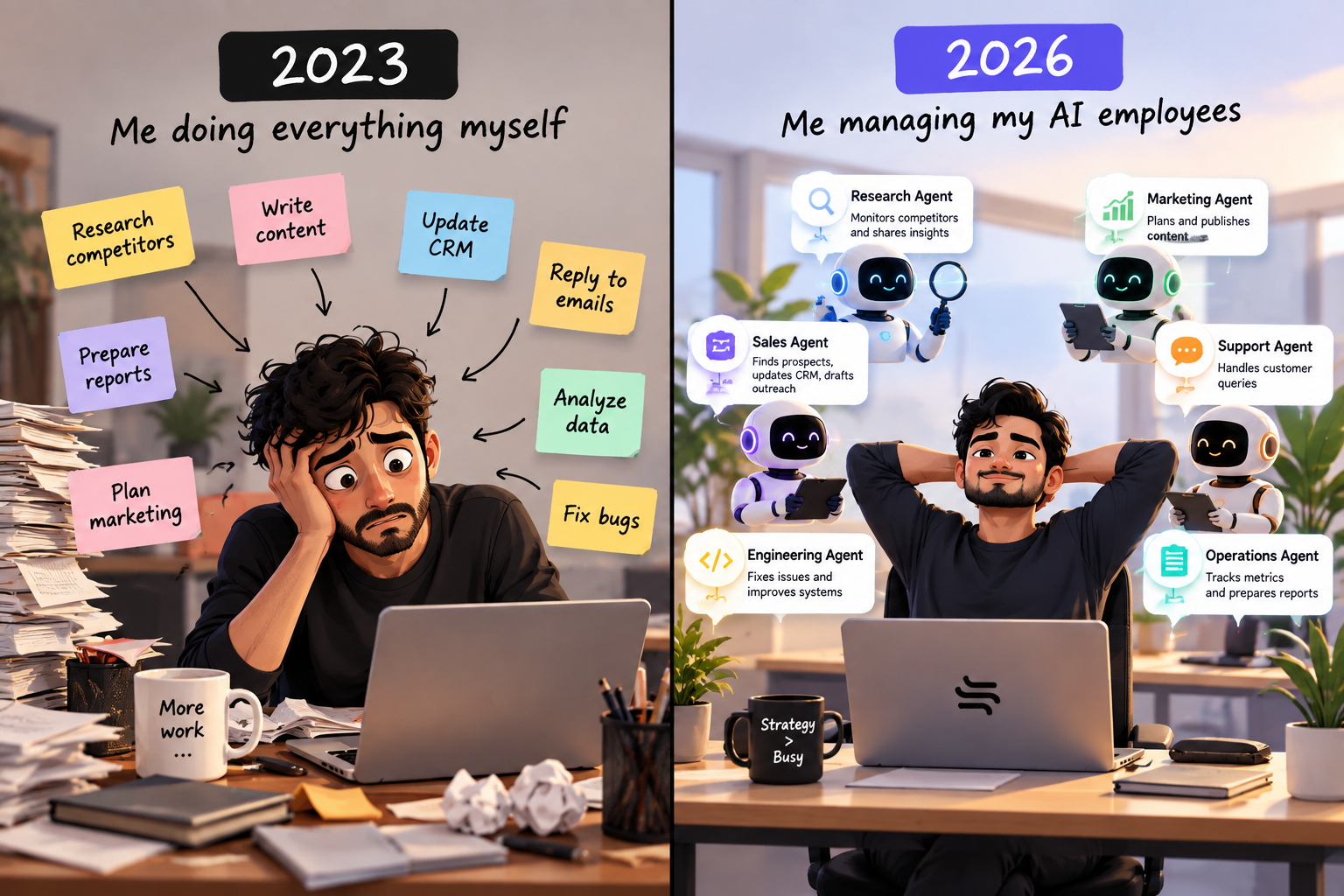
And employees may increasingly become managers of their own personal fleet of AI workers.
But humans aren't going away
This is where the AI employee narrative can become misleading.
The most valuable human work may actually become more important.
Intent
What are we actually trying to achieve?
Judgment
Is this the right decision?
Taste
Is this good enough?
Strategy
Which problem should we solve?
Relationships
How should we deal with a customer, employee, partner or investor?
Accountability
Who is responsible when something goes wrong?
Agents can increasingly execute.
But execution is not the same as judgment.
A company still needs people who can decide what is worth doing in the first place.
Microsoft's research reinforces this point. Among Indian AI users, for example, 63% prioritize quality control of AI output and 59% identify critical thinking as a top skill.
The future isn't necessarily:
Humans vs. AI
It is more likely:
Humans deciding what matters + agents executing more of it.
The hardest problem becomes trust
Once an AI is only answering questions, mistakes are usually visible.
Once an AI is taking actions, mistakes become operational.
An agent that produces a bad paragraph is annoying.
An agent that sends 10,000 incorrect emails is a business problem.
An agent that changes production infrastructure is a serious incident.
An agent that has access to financial systems introduces an entirely different category of risk.
This means the agent stack needs more than a good model.
It needs:
Identity
Who is this agent?
Permissions
What is it allowed to access?
Memory
What context should it retain?
Observability
What did it actually do?
Evaluation
How do we know whether it performed well?
Approval
When does a human need to intervene?
Auditability
Can we reconstruct its decisions afterwards?
OpenAI's current Dots architecture illustrates how this is becoming a product requirement rather than just a theoretical concern. Dots can work with connected applications and cloud computers, while enterprise controls include permissions around local computer access, cloud capabilities and custom action rules.
The agent doesn't just need intelligence.
It needs a job description, access policy and operating environment.
The agent becomes the new unit of software
This may be the biggest shift of all.
Traditional software is organized around features.
A CRM has:
- Contacts
- Deals
- Reports
- Automations
An agent can be organized around an outcome:
Grow the pipeline.
Traditional software exposes functionality.
Agents expose capability.
Instead of learning how 10 different tools work, the user increasingly describes what they want done.
The interface becomes:
“Find every customer whose usage dropped more than 30% this month, figure out why, identify the account owner and prepare a follow-up.”
The agent figures out which tools to use.
That means the abstraction layer is changing.
We used to build software around screens and features.
We are increasingly building software around intent and outcomes.
This changes what it means to build software
There is another consequence that is easy to miss.
If agents can build, operate and maintain parts of software themselves, then the amount of software being created could increase dramatically.
OpenAI's research on Codex usage found that agentic AI adoption has expanded beyond developers, while the complexity and duration of tasks assigned to agents have also increased. More than 10% of Codex users in its study managed three or more concurrent agents at some point in a week.
That means we're moving toward a world where:
software creates software that creates more software.
The scarce resource won't necessarily be code.
It may be:
- Good product judgment
- Distribution
- Proprietary context
- Trust
- Taste
- Customer relationships
- Reliable execution
Code is becoming easier to generate.
Knowing what should exist becomes more valuable.
The AI employee still has a long way to go
There is a temptation to look at today's agents and conclude that autonomous companies are just around the corner.
They aren't.
Agents still struggle with:
- Long-running reliability
- Ambiguous instructions
- Unexpected edge cases
- Changing environments
- Hallucinations
- Security
- Cost
- Coordination
- Knowing when to stop
The transition from:
“AI can do this”
to:
“I can trust AI to own this”
is enormous.
And that gap is where a lot of the next generation of AI infrastructure and applications will be built.
The real shift isn't AI replacing employees
The more interesting possibility is that every employee gets a team of agents.
A marketer with five AI agents.
A developer with ten.
A founder with twenty.
A recruiter with agents sourcing candidates, researching companies, scheduling interviews and preparing briefs.
A salesperson with agents researching accounts, updating CRM records, monitoring buying signals and preparing outreach.
The human becomes the person who:
sets direction → delegates → reviews → decides.
The agent becomes the person who:
researches → executes → monitors → reports.
Except the “person” is software.
So, are AI agents becoming employees?
Not literally.
But the direction is clear.
We are moving from:
AI that answers questions
to:
AI that completes tasks
to:
AI that manages workflows
and eventually:
AI that can be trusted with outcomes.
That final step changes much more than the software interface.
It changes how teams are structured.
How managers work.
How companies buy software.
How products are built.
And eventually, what a “job” itself looks like.
The biggest companies of the next decade may not simply have the best AI models.
They may be the companies that figure out how to combine humans, agents and software into entirely new operating systems for work.
The AI employee isn't here yet.
But the job description is already being written.
Sources: OpenAI Enterprise Signals and research on agentic work; Microsoft 2026 Work Trend Index; OpenAI research on Codex adoption and agentic AI. Statistics cited above refer to the specific populations and periods described by each source.