

Anyone can ask AI to write code. The difficult part is making sure that code actually works.
A developer can generate an entire feature with a few instructions, watch the code appear in seconds, and feel as though the hard work is finished. Then the tests fail, an existing feature breaks, or the generated code solves a problem nobody asked it to solve.
This is where the conversation around AI-native engineering needs to go deeper.
The real shift is not about learning clever prompts. It is about rethinking how software gets built when AI can participate in the engineering process itself.
The Prompt Is Only the Beginning
Most developers first experience AI through a chat window or a coding assistant. They describe a task, receive a response, make a few corrections, and repeat the process until the result looks right.
This is useful, but it has a limitation. The quality of the result depends on more than the wording of the request. AI also needs relevant context, access to the right tools, clear expectations, and a way to check whether its work is correct.
Imagine asking AI to fix a bug in a payment system. A prompt might explain the error, but the real solution could depend on how transactions are stored, how retries work, what happens when a request times out, and which other parts of the application rely on the same function.
A beautifully written prompt cannot compensate for missing information about the system.
Better prompts help AI understand a task. Better engineering helps AI complete the task reliably.

Context Is More Valuable Than Clever Instructions
Software does not exist as a collection of isolated functions. Every meaningful application contains relationships between files, modules, APIs, databases, configuration, and design decisions made over time.
AI needs to understand enough of those relationships to make a safe change. Without that context, it may generate code that looks reasonable in isolation but conflicts with the existing architecture.
Consider a developer working on an established React application. The task is to add a new form. The AI can generate a form component quickly, but the application may already have a shared validation library, a standard error-handling pattern, a design system, and conventions for managing API requests.
Ignoring those conventions could produce working code that still makes the application harder to maintain.
This is why repository instructions, relevant source files, documentation, type definitions, and existing tests matter. They give AI information about how the project actually works instead of forcing it to guess.
GitHub's Copilot documentation, for example, describes repository-level and path-specific instructions that can guide AI code reviews. It also supports AGENTS.md files for explaining project conventions and important architectural context.
The broader lesson is simple: context should be part of the engineering environment, not something a developer has to reconstruct from scratch in every conversation.
From Prompt Engineering to Workflow Engineering
Prompt engineering focuses on how to communicate with a model. Workflow engineering focuses on how the entire task moves from a request to a verified result.
The distinction becomes clearer when we compare two ways of building the same feature.
In the first approach, a developer asks AI to implement a feature, reviews the response, requests a few changes, and manually handles everything else. The AI helps with code generation, but the surrounding process remains unchanged.
In the second approach, the task begins with explicit requirements and acceptance criteria. AI can inspect relevant files, propose an implementation, edit code, run available checks, examine failures, and refine the change. The developer reviews the plan, evaluates the results, and decides whether the implementation is ready.
The second approach is not automatically better in every situation. It works well when the task is suitable for automation and the workflow provides useful feedback. For a small question or a simple function, a direct prompt may be all that is needed.
The important point is that complex engineering work benefits from a process that connects actions, observations, and verification.
Anthropic's engineering guidance on effective AI agents makes a related recommendation: start with the simplest approach that solves the problem, and introduce more complex agentic systems only when their additional capabilities justify the trade-offs.
AI-native engineering is not about making every task autonomous. It is about choosing the right level of AI involvement for the work at hand.
AI Agents Need Tools and Feedback
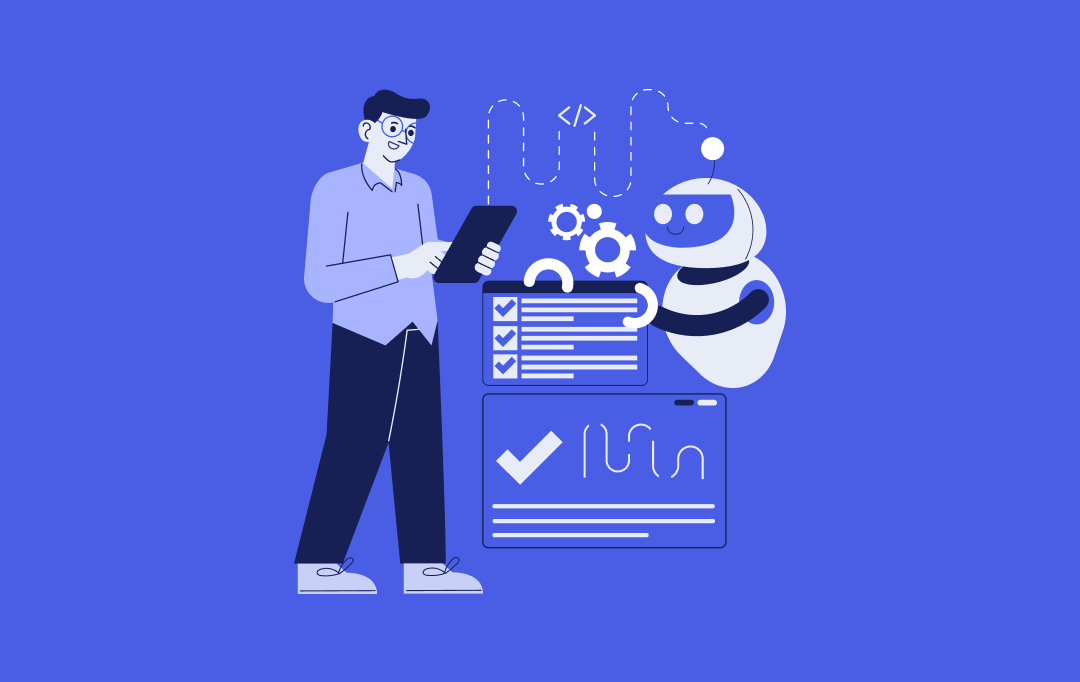
An AI model can suggest a solution in a conversation, but an engineering workflow becomes more capable when the system can interact with its environment.
Depending on the permissions and tools available, an AI coding agent may be able to inspect files, search a repository, edit code, execute tests, or use command-line tools. It can then use the results of those actions to decide what to do next.
This creates a feedback loop.
The agent makes a change, observes what happened, compares the result with the intended outcome, and adjusts its approach when necessary. Instead of relying entirely on its initial prediction, it can use evidence from the development environment.
For example, an agent implementing an API endpoint might generate the handler, run the relevant tests, discover that the response format is incorrect, and revise the implementation. A developer can review the resulting changes rather than manually performing every intermediate step.
However, access to tools also creates risks. An agent can make incorrect edits, execute an unsafe command, or misunderstand the result of a test. Its permissions should therefore match the task, and sensitive or irreversible actions may require explicit human approval.
The goal is not unlimited autonomy. It is controlled autonomy with observable results.
Testing Becomes the Ground Truth
Generated code can look convincing even when it is wrong. It may compile successfully, follow familiar patterns, and still fail under conditions that were never considered.
This makes verification a central part of AI-native engineering.
A developer should not treat an AI model's confidence or explanation as proof that the implementation is correct. The system needs independent ways to check its behavior, including automated tests, type checking, static analysis, security scanning, and code review where appropriate.
Suppose AI changes a function that calculates discounts. A basic test might confirm that a ten percent discount works for an ordinary purchase. But what happens when the purchase amount is zero? What if the discount exceeds the permitted limit? What if the input is missing or the value is unexpectedly negative?
Good tests examine the requirements and the edge cases, not just the example that inspired the implementation.
For more complex agentic systems, evaluation must also cover the agent's behavior across multiple steps. Did it use the right tools? Did it respect constraints? Did it recover correctly from errors? Did it finish the task without introducing unwanted changes?
Anthropic's research on evaluating AI agents emphasizes the value of systematic evaluations for identifying failures before they reach users.
The principle applies to software engineering as well: AI should produce work that can be checked, not work that merely sounds correct.

Why Faster Code Generation Does Not Always Mean Faster Development
One of the most tempting assumptions about AI coding tools is that generating code faster automatically makes software development faster.
But coding is only one part of the development process. Developers also spend time understanding requirements, navigating unfamiliar code, debugging failures, reviewing changes, integrating components, and maintaining systems after release.
AI can reduce some of that work while increasing other parts. A large generated change may take longer to review than a small, carefully scoped implementation. An incorrect suggestion can create debugging work that would not otherwise have existed.
Google's DORA 2025 research, based on survey responses from nearly 5,000 technology professionals and more than 100 hours of qualitative research, describes AI as an amplifier of existing strengths and weaknesses. Its findings also highlight the importance of testing, version control, and fast feedback loops as teams adopt AI.
This does not mean AI slows development. It means the outcome depends on the entire system surrounding the tool.
A useful engineering workflow therefore measures more than the volume of generated code. It considers whether changes pass review, whether defects increase, how quickly problems are resolved, and whether the resulting software remains maintainable.
The real objective is not to maximize the speed of code production. It is to shorten the path from a well-defined problem to a reliable solution.
The Engineer Still Owns the Decisions
As AI takes on more implementation work, the engineer's responsibility changes in emphasis, but it does not disappear.
Someone still needs to decide whether the requirement makes sense, whether the architecture is appropriate, whether the proposed solution introduces unnecessary complexity, and whether the final behavior is safe for its intended use.
These decisions require more than familiarity with prompts. They require an understanding of programming fundamentals, system design, debugging, testing, security, and the trade-offs involved in building software.
A developer who understands the system can use AI to explore several approaches, compare their consequences, and implement the most suitable option. A developer who cannot evaluate the output may accept an answer simply because it looks professional.
That difference becomes especially important as AI-generated changes grow larger and involve more parts of a codebase.
The best use of AI is not to remove human judgment from the process. It is to give engineers more ways to investigate problems, test ideas, and make informed decisions.
What AI-Native Engineering Looks Like in Practice
An effective AI-native workflow can be built around a few practical principles.
Start with a clear outcome. Describe what the software must do, what constraints it must respect, and how success will be measured.
Give AI the right context. Provide relevant code, project conventions, architecture notes, and documentation. Avoid overwhelming the model with unrelated information.
Break complex work into reviewable changes. Smaller steps make it easier to identify mistakes and understand why a change was made.
Connect actions to feedback. Use tools, tests, and actual execution results to guide the next step instead of relying entirely on generated explanations.
Verify independently. Review the code and run appropriate checks. Treat generated output as a proposal until there is evidence that it meets the requirements.
Keep humans responsible for important decisions. Define boundaries for permissions, security-sensitive changes, production operations, and other high-impact actions.
These principles do not require a completely autonomous development environment. They can improve a workflow that uses a basic coding assistant, and they become even more important when AI agents can take actions across a repository.
The aim is to create a development process in which AI is useful not just at producing code, but at helping move a task toward a verified outcome.
The Real Meaning of AI-Native Engineering
AI-native engineering is often discussed through the tools developers use: coding assistants, agents, models, and automated workflows. Those tools matter, but they are only part of the story.
The deeper change is in the way engineering work is organized. Context becomes easier to access. Tasks become clearer to specify. Tools allow AI to act on real systems. Feedback helps it correct mistakes. Tests and human review establish whether the result is acceptable.
Prompting remains useful, but it is not the foundation on which reliable engineering depends. The foundation is a process that connects intent, implementation, evidence, and judgment.
As AI becomes more capable, the advantage will not belong only to developers who know how to ask it for code. It will belong to those who understand how to build systems around its strengths and limitations.
Because software engineering has never been only about producing code. It has always been about making sure the code solves the right problem, works under real conditions, and can be trusted after it ships.
"prompting tells ai what to try. engineering determines whether the result deserves to ship."